
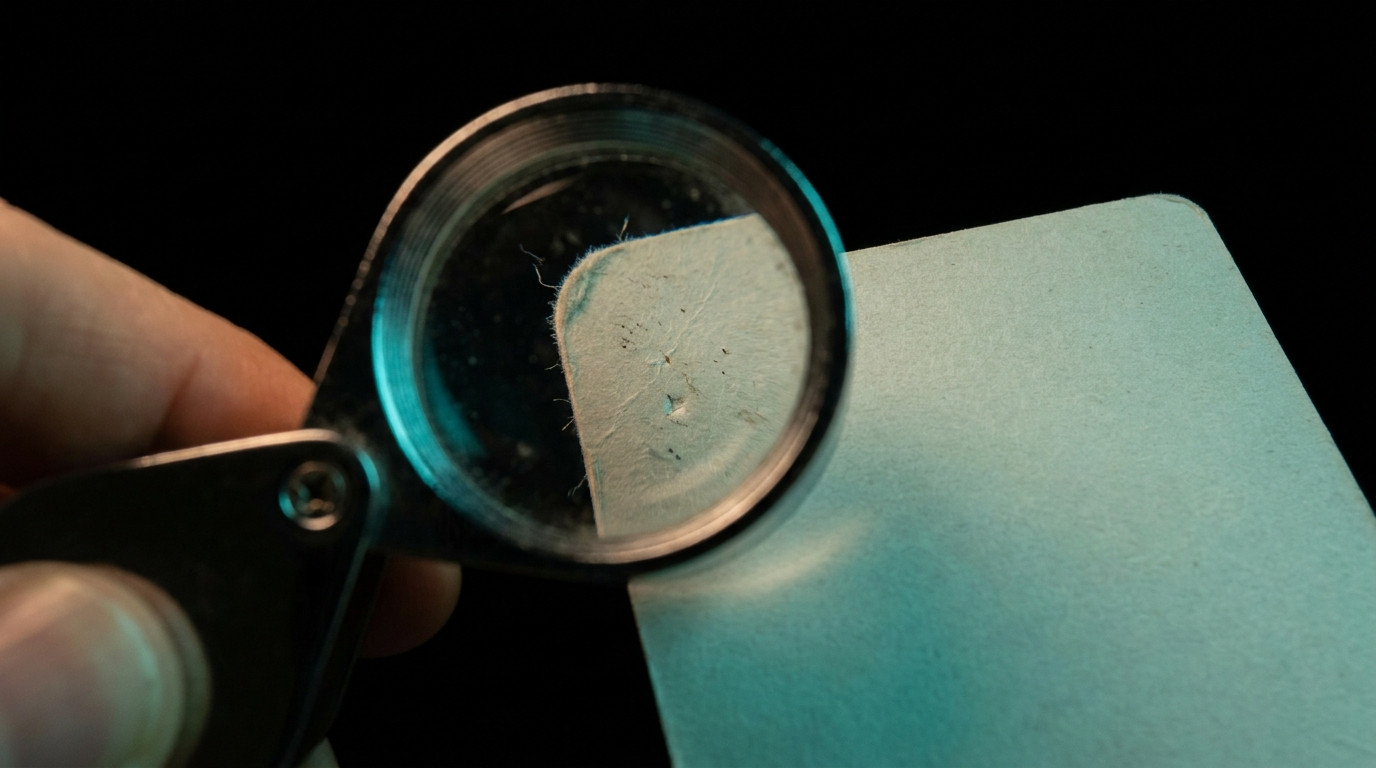
Grading is not a search for what is good about a card. It is a search for the single worst thing on it, because that one thing is what you are paying to have measured. A card with three immaculate categories and one soft corner does not average out to a strong grade — it gets held down to the corner. Learn to find the worst thing yourself, at your own desk, and most of the cards you were about to submit will disqualify themselves in under a minute.
▸ THE QUICK VERSION
Four categories to inspect: centering, corners, edges, surface. Beckett and CGC report all four as standard; PSA offers them as a paid extra on some service levels; SGC returns a single grade.
The lowest one sets a ceiling. It is a floor rule, not an average — one flaw caps the whole card.
Centering is the cruellest, because it was printed in at the factory. It is capped as hard as corners, and unlike corners you cannot do anything about it.
Your kit is a lamp, a matte black surface, a millimetre ruler, and your phone's macro mode. That is enough to predict most of the outcome.
The four things Beckett and CGC score
CENTERING · CORNERS · EDGES · SURFACE
Centering is how evenly the printed image sits inside the card's borders, measured as a ratio of one border against its opposite. Corners is the sharpness of all eight corner points — four on the front, four on the back. Edges covers the cut sides: chipping, nicks, and the pale fraying collectors call whitening. Surface is everything on the two flat faces — scratches, print lines, dimples, creases, gloss loss, staining.
Beckett issues those four as subgrades on its label, and CGC scores the same four. PSA's published standards are not built that way — they describe centering, corners, gloss, staining, focus and edge chipping narratively inside each grade rather than as four scored categories — and SGC returns a single grade. So treat the four as your own inspection checklist, because they are what you can actually see at a desk, not as a promise about the shape of the number that comes back.
The rule that decides everything
THE WEAKEST CATEGORY SETS THE CEILING
Beckett prints four subgrades on its label, which makes it the clearest window into how all of this works. The rule its graders are understood to apply — reverse-engineered by collectors from thousands of labels, not published by Beckett in this form — goes like this. When the weakest category is centering or corners, the overall grade sits no more than half a point above it. When the weakest is edges or surface, the overall can rise a full point — rarely, and only on an aggregate condition. That extra half is conditional on the other three: collectors state the rule as each of them sitting at least a point and a half to two points above the lowest subgrade. One of the three falling short is enough to withhold it. If the two lowest subgrades match, that number becomes the grade. Treat it as a rule of thumb collectors maintain, not a formula anyone has published, and check the grader's current standards page before you lean on it.
PSA's standard service returns one overall number; subgrades are an optional extra on some service levels, and no aggregation formula is published either way. What a submitter experiences is the same shape regardless: one bad category, one capped card. So when you inspect your own card, stop hunting for reasons it deserves a ten. Find its floor.
ONE CARD · FOUR SUBGRADES · ONE CEILING
Centering: the flaw that was printed in
MEASURE IT, DO NOT EYEBALL IT
Centering is the flaw collectors name most often when a submission comes back under expectation — no grader publishes a breakdown of what actually costs cards their grade, so take that as consensus and not as data — and it is the one defect that has nothing to do with how the card was treated. It happened on the cutting line before anybody opened the pack. Eyes are unreliable here too: a bright border reads as wider than a dark one at the same measurement, and a card that looks fine flat on a desk can be visibly off once it is sitting inside a slab.
So measure. Put a millimetre ruler across the left and right borders and note both numbers. Divide the wider border by the two added together, and you have your ratio, written wide side first. A card with a 2.2 mm left border and a 1.8 mm right border totals 4.0 mm, so it reads 55/45. Repeat top to bottom, then do the back — the back is graded too, and it is usually worse.
PSA's published Gem Mint 10 standard puts the tolerance at approximately 55/45 on the front and 75/25 on the reverse — that is the psacard.com grading standards page as it read on 29 August 2026, the date everything below was checked against. There is no published eye-appeal allowance on centering — the leeway PSA does describe at Gem Mint is for a slight printing imperfection that does not impair the card's overall appeal, which is a different thing entirely. The front figure used to be a range. For years PSA's wording read approximately 55/45 to 60/40 on the front; the upper bound is gone from the current page, removed quietly during 2025 without an announcement. Older guides quoting the range are not wrong about what PSA used to publish; they are quoting a page that has moved underneath them. Which is the real lesson: treat 55/45 as the outer edge rather than a comfortable spot inside a band, and read the grader's current page yourself before you commit to a submission, because this number has already moved once.
READING A CENTERING RATIO
Corners and edges: work against black
THE CONTRAST TEST

Lay the card on something matte and black — a mousepad, a closed laptop lid, a play mat. Anything pale hides whitening, and whitening is the finding submitters most often say caught them out once the card came back. Under a good lamp, against black, the damage announces itself.
Go corner by corner, all eight of them. You are looking for three things: a corner that has gone soft and rounded instead of holding a point, a corner showing a pale dot where the white stock underneath has been exposed, and any fuzz or lifted fibre at the tip. Then run your eye along all four cut edges. Be ruthless with dark-bordered cards in particular — a black border turns even a hair of edge wear into a bright silver line, which is why collectors treat dark-bordered cards as harder to gem than the light-bordered equivalents pulled from the same pack.
If you have to tilt the card, squint, and argue with yourself about whether a corner is soft, it is soft. A grader will spend seconds on it under strong light and will not give you the benefit of the doubt.
THREE FINDINGS · AND WHY BLACK BORDERS PUNISH
Surface: tilt it into the light
RAKING LIGHT FINDS WHAT FLAT LIGHT HIDES
Surface flaws are invisible head-on and obvious at an angle. Hold the card up and rotate it slowly against a single light source, so the light rakes across the face rather than shining straight at it. Do it in both orientations, and do it to the back.
What appears: print lines, faint straight bands from the press running the length of the card; dimples, small pressure marks often left by a fingertip; scratches in the foil, which holo and full-art cards collect inside the pack itself; roller marks, subtle parallel ripples in the stock; and indentations pressed through from a pen used on top of a stack. A card straight out of a fresh pack is not automatically clean — print lines and foil scratches are made before the wrapper is ever sealed.

One more pass. Hold the card up to a bright light with the face toward you. A crease that is invisible in reflected light shows as a dark line where the fibres have broken. A crease is not a small deduction. It is a different grade entirely.
ONE CARD FACE · THREE ANGLES OF LIGHT
You are not looking for the best thing about the card. You are looking for the thing that caps it.
The five-minute pre-flight
RUN THIS BEFORE YOU FILL IN A SUBMISSION FORM
Whatever number that produces is your realistic expectation, not your hope. Take it back to the break-even and compare. If the card only pays for itself at a grade above your own honest ceiling, you have your answer — and it cost you five minutes instead of a submission fee and however long the wait runs. That wait is set by the service level you pay for, not by the card — the tiers stretch from a few business days at the top end to months at the cheapest, and the published turnarounds move, so check the grader's current times alongside its current fees.
Every card I have been wrong about, I was wrong about in the same direction. I graded the artwork and forgot to grade the corner.
READ MORE FROM THIS WRITER ›
THE REST OF THIS ROUTE
Run the Break-EvenStep 01 — fee, shipping, insurance and the wait, added up before you spend anything. READ → When Raw WinsStep 03 — the cards worth more sleeved and in your hands than sealed in plastic. READ → How to Know When to Slab a CardIan's own decision rule, written from the far side of a lot of submissions. READ → Should You Grade It↑ The chapter — the whole decision, from the ledger to the call. THE CHAPTER →