01
How to read a sleeve packet and know what you are buying
Microns per wall, inner against outer, and the two lines on the back of the pack that decide whether the deck still fits.
BY POPPY · 6 MIN
 How To: Gaming
THE HOW TO CO. — EDITION 10
How To: Gaming
THE HOW TO CO. — EDITION 10
A micron rates one wall of film. You buy two of them per card, a hundred cards at a time — and the box you have to put them back in has not changed size.
WHAT THE NUMBER ON THE PACKET MEANS
A micron rates one wall. You are buying two of them, a hundred cards at a time.
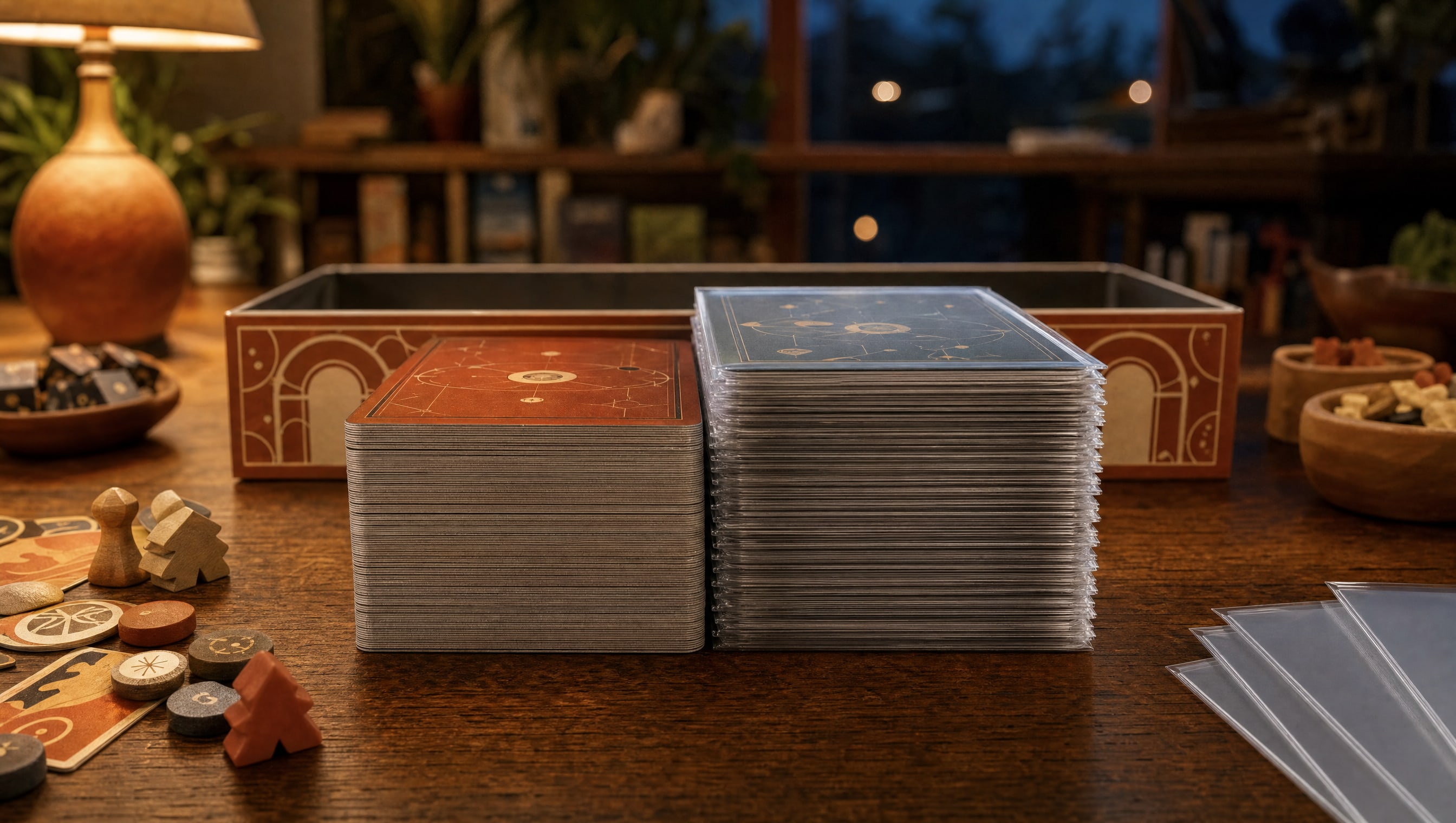
Forty. Sixty. A hundred. The number printed on a pack of sleeves is the thickness of one wall of film in microns — a thousandth of a millimetre — and a sleeve has two walls, so the packet's number is doubled before it touches a card and then multiplied by however many cards the game shipped. A card starts at about 0.31 mm. A hundred of them make a deck 31 mm tall. Sleeve the same hundred in standard 60-micron film and the deck is 43 mm, which is five more than the slot most publishers moulded for it. That arithmetic is the only part of this argument with a right answer. Everything after it — matte or clear, which games earn the money, whether the metal coins were worth it — is taste, budget, and one rule about resale that most people learn the expensive way.
01 · THE WALL
Thin film feels like a bag; thick film shuffles like a card in its own right. Between 40 and 100 microns the difference in how long a sleeve survives is real but small — sleeves nearly always fail at the seam, or get bent at the corner, long before the film wears through. What changes enormously is handling: how the deck riffles, how it sits in a hand, how much it fights you when you fan it. Buy for the way it shuffles, not for armour.
02 · THE FIT
Perfect-fit sleeves are cut to the card rather than to your hand. At around 40 microns they are the cheapest way to keep a deck clean while it still goes back in its own tray, and they are also the layer that goes underneath if you double-sleeve. Double-sleeving a hundred cards in a 40-micron inner and a 100-micron outer adds 0.28 mm to every card — a 59 mm deck out of a 31 mm one, for a slot that was cut at 38. Worth knowing before you order two hundred sleeves.
03 · THE UPGRADE
Metal coins, wooden resources, an acrylic marker for whoever goes first: upgrades change what a game feels like in the hand, which is a real pleasure. They also change two things nobody checks. Weight — a set of metal coins runs several hundred grams heavier than the punchboard it replaces, and the shelf underneath is already carrying kilos. And volume, because upgraded bits almost never drop into the moulded tray the originals came out of.
04 · THE RESALE
Keep everything you replaced. What costs a game money second-hand is not wear, it is missing parts — so the cardboard coins go in a labelled bag and the original insert stays in the box even when a foam-core tray is doing the actual work. Sleeves are worth nothing on resale and plenty of buyers will ask you to strip them, which is fine. Writing on cards, trimming them to fit a sleeve and gluing an insert down are the three things that cannot be undone, and none of them has an upside.
THE DETAIL
A game card is about 0.31 mm — two printed paper plies bonded either side of an opaque core, which is what stops a lamp reading the face through the back. Drawn here in section at a magnification where a micron is a visible length: the same card, at the same size, in all five cuts, with the grades actually on sale laid round it as the walls they are. The card is the constant and the film is the variable, and the cuts are hung close enough together that the film of one grade sits directly against the film of the one above it. Under them, the delta on its own rule — what each grade ADDS to a card, five bars on one baseline, measured against the card itself. A perfect fit adds 0.08 mm. A premium matte adds 0.20 — two centimetres of extra deck by the time you have sleeved a hundred of them.
5 PIECES · ON THE TABLE
Five pieces queued for this space. The titles are set and the drafts are moving; nothing here is linked until the page exists, because a door that opens onto nothing costs you a click to find out.
01
Microns per wall, inner against outer, and the two lines on the back of the pack that decide whether the deck still fits.
BY POPPY · 6 MIN
02
The order to work in, why the carpet is the enemy, and the ten seconds per card that stop you doing it twice.
BY IRIS · 5 MIN
03
Riffling kills sleeves and nothing else does. The two shuffles that do the same job to a sleeved deck and leave it intact.
BY IRIS · 4 MIN
04
Weigh it, measure the tray, and bag what you took out. The upgrade is reversible or it is a cost.
BY POPPY · 7 MIN
05
Twenty minutes, a clean table, and why the buyer almost always wants the cards bare and the sleeves kept.
BY POPPY · 5 MIN
FROM THE CURATOR
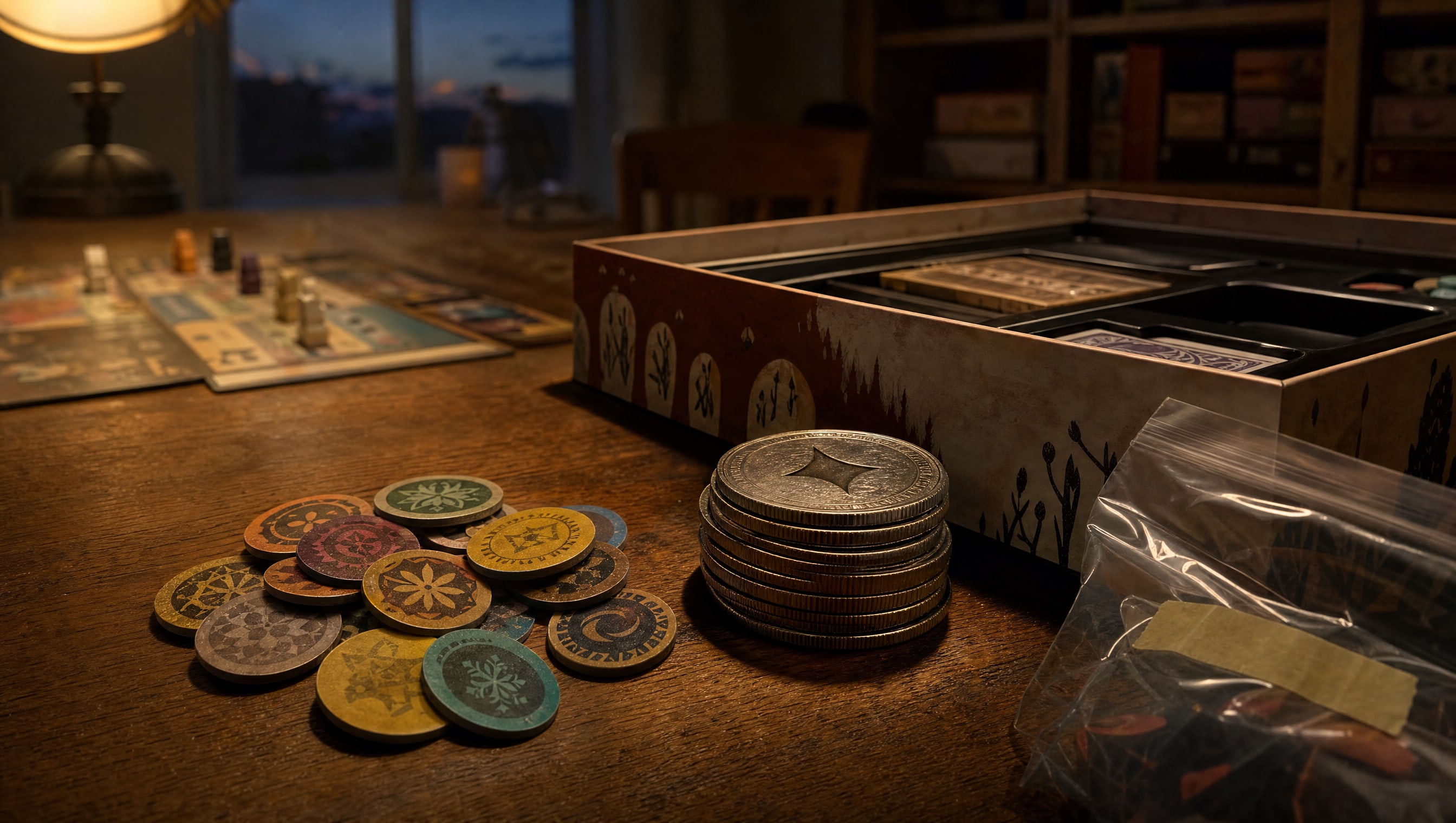
The metal ones were lovely and I do not regret them for a second. What I regret is the bin. Two years later I passed the game on, the buyer asked whether it was complete, and I had to say that it was complete apart from the currency — which knocked a third off what it was worth and made the whole conversation slightly embarrassing. The coins cost me forty pounds. Losing the originals cost me more than that. Everything I replace now goes into a freezer bag with the game’s name on it in marker, taped inside the lid, and the game stays worth exactly what it was worth before I improved it.
BY POPPY — CLASS: CURATOR · THEPINKPIPER.GG
SPACE 13 / 16 · PATH 02 OF 03 · SLEEVES & UPGRADES
CHAPTERS ON THIS BOARD
You are on space 13, Collecting & Care, standing on the second of the three paths it prices — sleeves. Back to the board to roll for another.