01
How to teach any game in four minutes
The four stops on the plate above, said out loud, with the exact wording for each one and the two places a teach reliably runs long.
BY POPPY · 5 MIN
 How To: Gaming
THE HOW TO CO. — EDITION 10
How To: Gaming
THE HOW TO CO. — EDITION 10
The chapter’s four-minute teach, opened up: minutes four to eight of the same clock, four stops, and a book that stays shut except once. The order below is not the rulebook’s order, and that is the whole trick.
WHY READING IT ALOUD FAILS
A rulebook is written to settle arguments. Nobody at your table is having an argument yet.
It is ordered for the person who is stuck on turn nine — components, setup, then a turn, then scoring, then a page of edge cases. Said out loud from the top, that order hands four people a list of things they cannot use yet and no reason to hold on to any of it. Four minutes in — the point at which a teach should be finished — the only sentence anyone has retained is the one about the tiebreaker.
So the teach runs on a different order from the book. You say how the game ends before you say anything else, because every rule after that has somewhere to attach. Then you play a turn in front of them rather than describing one. Then you name the menu of choices a turn can be. Exceptions get flagged and left where they are until somebody actually hits one — and by then they are asking, which is the only time a rule ever lands.
The rulebook stays on the table the whole time. You open it once, for the diagram, and turn it round to face them.

THE DETAIL
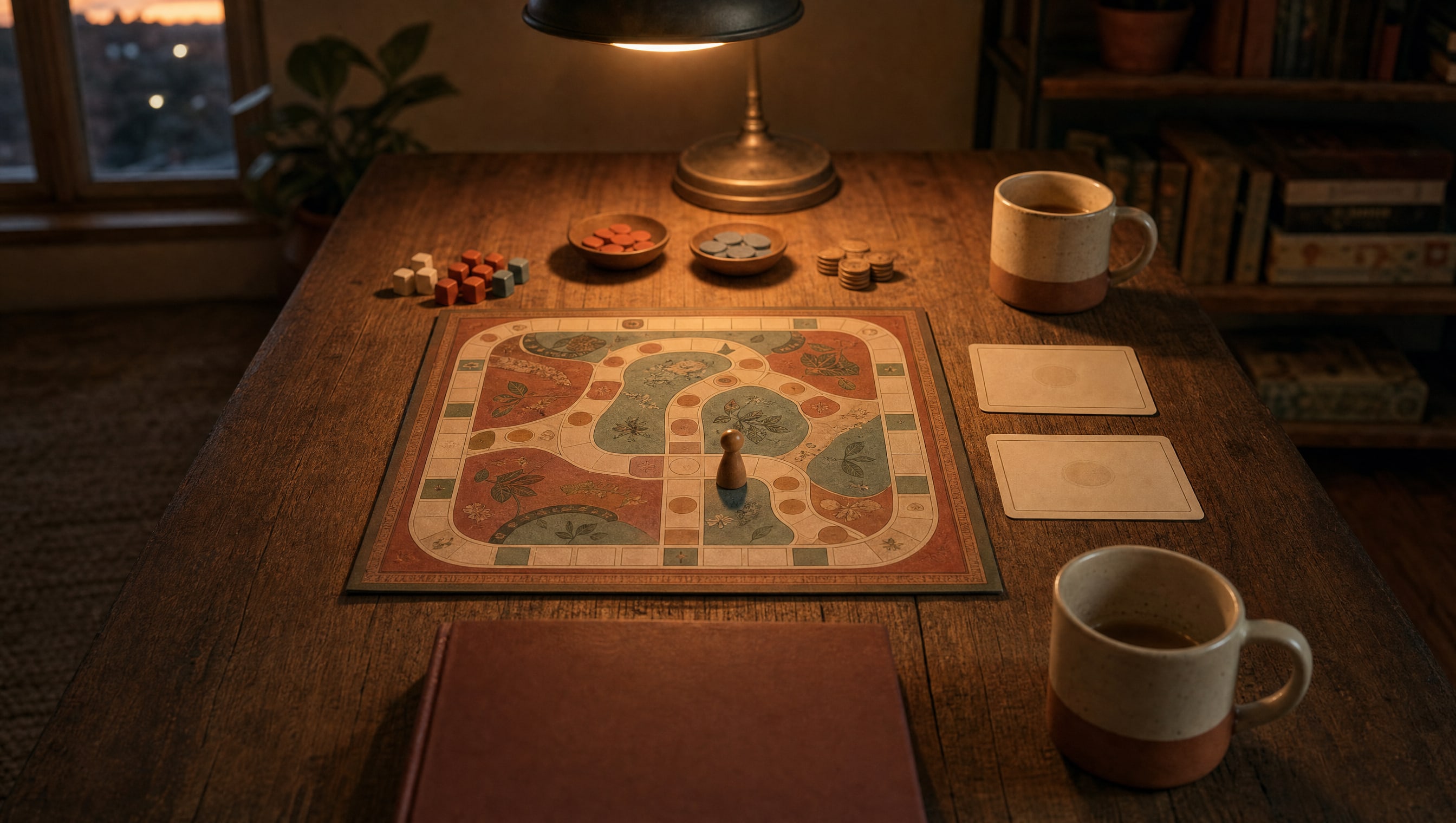
This is the chapter’s four-minute teach — minutes four to eight of its clock, the stretch it brackets and nothing else — opened up into the four stops it is actually made of. The clock below is that same clock, which is why it starts at 4:00: setup is already behind you. Stop 01 is the chapter’s one-minute hook, whole. Stops 02 to 04 are the three minutes it marks as the first turn, re-divided. Length along the route is elapsed time at one scale throughout, so the thirty seconds you spend flagging exceptions is genuinely a third of the turn you play out loud.
FROM THE CURATOR
The sentence I now open with is always the same shape: the game ends when someone does this, and whoever has most of that wins. It takes about eight seconds and it changes what everyone hears afterwards. Every action I describe from that point is obviously either useful or not, and people work that out themselves instead of waiting for me to tell them.
The habit that took me longest to break was answering questions in order of when they were asked. Half of them are exceptions, and an exception answered before anyone has hit it costs you a minute and buys nothing. I say "that one comes up, I will flag it when it does" and move on. Nobody has ever minded. They mind the twelfth minute of a teach.
BY POPPY — CLASS: CURATOR · THEPINKPIPER.GG
5 PIECES · ON THE TABLE
What this path is holding room for. Nothing here is a link yet — these are the pieces being written for this space, and a door that opens onto nothing costs you a click to find out.
01
The four stops on the plate above, said out loud, with the exact wording for each one and the two places a teach reliably runs long.
BY POPPY · 5 MIN
02
One sentence, about eight seconds, and every rule you say afterwards has somewhere to attach itself.
BY POPPY · 4 MIN
03
Take a real turn in front of them, narrate the decision rather than the procedure, and let the board do the explaining.
BY IRIS · 5 MIN
04
The polite deferral that costs nothing, and why answering questions in the order they arrive is what makes a teach sprawl.
BY IRIS · 5 MIN
05
Three tells that arrive in the same order every time, and the one sentence that gets everybody back without restarting.
BY POPPY · 4 MIN
SPACE 01 / 16 · CHAPTER 01 · LEARNING & TEACHING
CHAPTERS ON THIS BOARD
Every chapter in this region is a space on this board. This one is 01. Back to the board to roll for another.