01
How to Win Game Night Without Making Enemies
You are the host, the teacher and a player, and the third one is the job that quietly makes the other two harder. How to play to win from the chair that runs the night.
BY POPPY · 6 MIN
 How To: Gaming
THE HOW TO CO. — EDITION 10
How To: Gaming
THE HOW TO CO. — EDITION 10
The chapter measured the table. This path measures the evening: four hours, five phases, one teach, and the eighty minutes in the middle of it when your hands are not on the game.
WHY THE NIGHT NEEDS A CLOCK
Nobody cancels a game night. They just end up starting the good game at half past ten.
The chapter above measured the room — the table, the reach, the thirty centimetres of board that four seated people can all touch. That answers what fits. It says nothing about when, and when is what actually goes wrong. A night that dies rarely dies because of the box. It dies because the fourth guest arrived at ten past eight, the rules got taught twice, and the game everybody came for was dealt at twenty-five past ten to four people who had already eaten.
Every one of those is a scheduling failure, and scheduling is the one part of the evening you control on your own, before anybody knocks. Two decisions do most of the work. The first is the time you stop waiting: pick it, say it out loud when you invite people, and start teaching five minutes later whether or not everyone is sitting down. The second is the size of the first box — not the best game you own, the one you can teach in ten minutes and finish in an hour, because it is the game that buys you the peak.
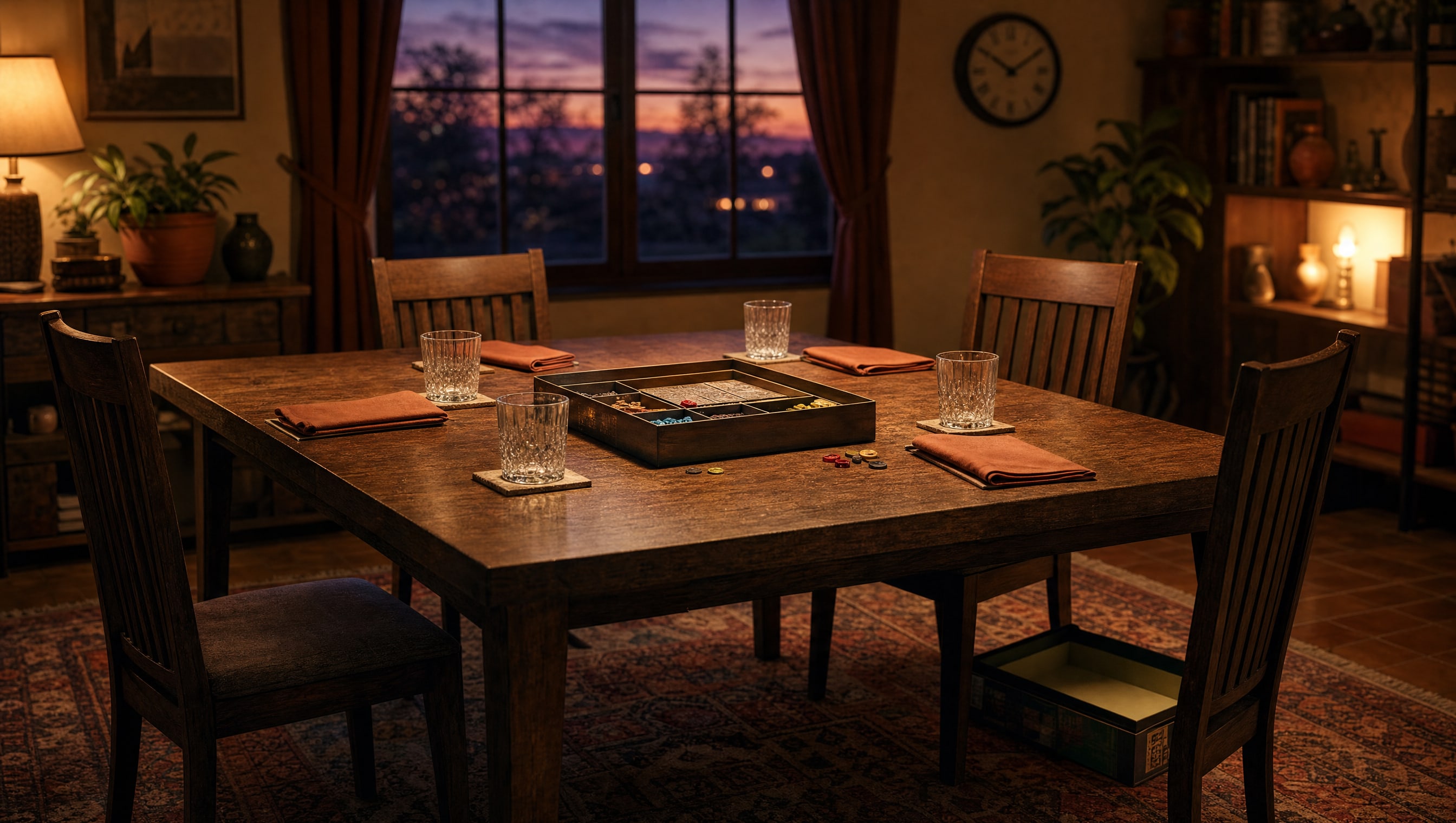
The plate below is one ordinary evening drawn against a real clock. Everything on it is measured the same way: length is time, from the doorbell to the coats.
THE DETAIL
One evening, half past seven to half past eleven, drawn at one scale throughout — length on this plate is time, so the ten-minute teach really is a sliver and the peak really is a third of the night. The step above the ribbon is the head count coming through your door; the dashed rung across it is the four seats the chapter measured, the point at which the shared board is still thirty centimetres and not a beer mat. Underneath, the four stretches where your hands are not on the game. They add up to eighty of the two hundred and forty minutes.
THE SAME EVENING, IN WORDS
The plate above is the argument; this is the version you can read off your phone in the kitchen. Times are the ones drawn on the clock, not rounded for print.
19:30
Coats, drinks, the snack table already loaded. The box is open on the table and nobody is asked to learn anything.
20:05
Whoever is here is the table. This is the number you said when you invited people, and holding it is the whole job.
20:10
How it ends first, then one turn played out loud. Latecomers get taught by the table, not by you starting again.
20:20
An hour, taught in ten. Its job is not to be the best game of the night — its job is to get everybody playing before nine.
21:20
Ten minutes to clear the wood and restock the side table, then deal the game they were actually invited for.
22:20
The last box that can still finish. After it, the answer to "one more?" is a filler or the kettle.
22:50
A short game while the table thins out. Boxing up starts now, not at the door, or you do it alone at midnight.
23:30
Four hours, five phases, and eighty minutes of it spent hosting rather than playing. Plan for that and it stops being a surprise.
FROM THE CURATOR
For years my invitations said "from about half seven", which is not a time, it is a mood. So people arrived across an hour, I taught the same game to three separate arrivals, and by the time we started properly the evening had eaten its own first half. The fix was embarrassingly small: I put a second time in the message. Doors from half seven, the door shuts at five past eight and the teach starts at ten past. Nobody has ever been offended by it and almost nobody has been late twice.
The other thing I got wrong for years was leading with my favourite box. The first game is not the point of the night — it is the thing that gets four people playing instead of talking about playing, and then earns you two clear hours for the game you actually wanted. Now the first box is always one I can teach in ten minutes and finish in an hour, and I do not care very much which one it is.
BY POPPY — CLASS: CURATOR · THEPINKPIPER.GG
5 PIECES · ON THE TABLE
The pieces being written for this path. Nothing here is a link yet — a door that opens onto nothing costs you a click to find out, so the titles are set and the rooms come later.
01
You are the host, the teacher and a player, and the third one is the job that quietly makes the other two harder. How to play to win from the chair that runs the night.
BY POPPY · 6 MIN
02
The ten-minute slot on the plate above, and what it looks like when the box is simple enough to halve it. How it ends first, then one turn played out loud.
BY IRIS · 5 MIN
03
Everything that leaves a mark on a card belongs on the side table the chapter drew, and there is an order to loading it before anybody arrives.
BY POPPY · 6 MIN
04
Two times in the invitation instead of one — doors, then teach — and what to say when somebody is still twenty minutes out at five past.
BY IRIS · 4 MIN
05
The last box that can still finish, the filler that covers the thinning table, and why the boxing up starts at ten to eleven and not at the door.
BY POPPY · 5 MIN
SPACE 03 / 16 · CHAPTER 02 · GAME NIGHT · PATH 01 OF 03
Every chapter in this region is a space on this board. This one is 03, and you are standing on the first of its three paths — Hosting Game Night. Back to the board to roll for another.