01
How to Pick a Great Two-Player Game
Duel or build: work out which shape your table is set up for before you work out which box you want. The plan above decides it faster than a review does.
BY IRIS · 6 MIN
 How To: Gaming
THE HOW TO CO. — EDITION 10
How To: Gaming
THE HOW TO CO. — EDITION 10
Two seats, sixty-six centimetres of reachable middle, and a corner each that nobody else can touch. The head count changes the geometry before it changes the shelf.
TWO SEATS
Two players is the only head count where the table stops arguing with you.
The chapter above this one measured an ordinary dining table and found the middle of it. At four seats the square everybody can reach is about thirty centimetres across, which is why a four-player night is really a night about one small patch of wood. Take two chairs away and that square becomes sixty-six centimetres — nearly five times the area, on the same table, for free. Nothing else in this region hands back that much surface without anybody buying anything.
So a two-player night is not a game night with people missing. It is the only night that can hold a big game. The heavy box with the long board, the one that gets refused on a Friday because four people would be sitting round the edge of it watching two people play — that box works here, and it works because of the geometry rather than because of anybody’s taste.
The bigger change is the one nobody measures. At four seats every part of the table is reachable by somebody and not by somebody else, so nothing can be left anywhere. At two, the table splits cleanly: about half of it is shared, a tenth of it is dead corner nobody can touch, and the rest — roughly a third of a square metre each — belongs to exactly one of you. Private table. That is the thing four seats does not have, and it is what an entire family of two-player games is built on.
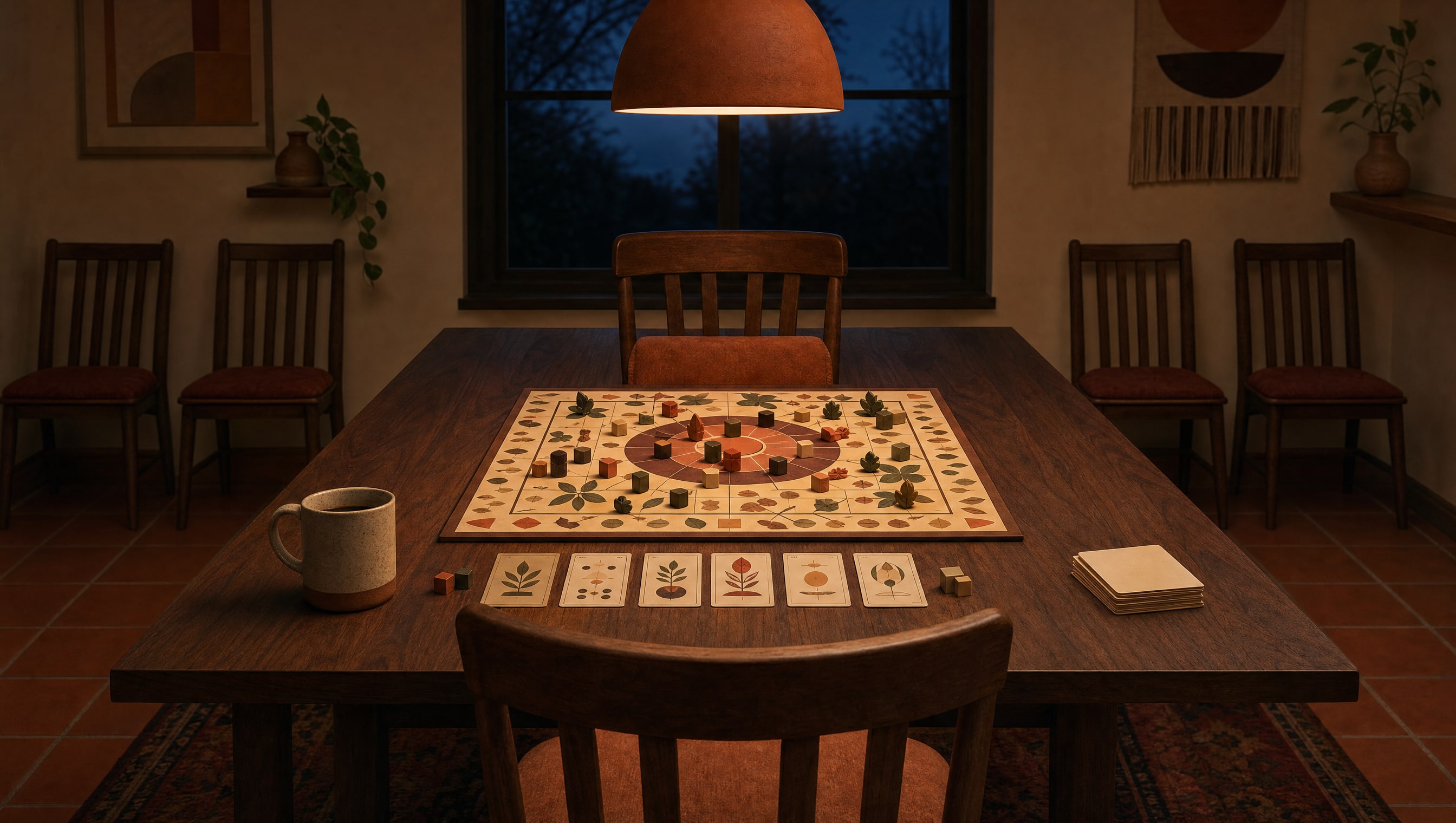
Which gives you the fork. A duel keeps everything in the shared middle: one board, both pairs of hands, nothing anybody owns. A build shares a narrow row and gives each player their own area to work in — Patchwork and Jaipur both spend a table that way. Same two chairs, completely different use of the wood, and the plan below draws them at the same scale so you can see which one your table is actually set up for.
THE DETAIL
Both plans are the identical 180 by 90 centimetre table from the chapter above, with two seats instead of four and the same eighty-five centimetres of seated reach. The shading is not decoration: the tinted field is what both of you can touch, the two hatches are the corners only one of you can, and the plain cream at the ends is out of everybody’s reach. On this table that works out at 50 per cent shared, 20 per cent yours, 20 per cent theirs and 10 per cent dead. A duel puts every piece in the shared field and leaves the corners empty. A build puts a 70 by 16 row in the middle and sends 1,860 square centimetres of personal board out into corners that only exist because there are two of you.
5 PIECES · ON THE TABLE
What this path is holding room for. Nothing here is a link yet — these are the pieces being written for this space.
01
Duel or build: work out which shape your table is set up for before you work out which box you want. The plan above decides it faster than a review does.
BY IRIS · 6 MIN
02
The same opponent every week beats you into a pattern. Handicaps, side swaps and asymmetric starts that keep a rematch honest without anybody being humoured.
BY IRIS · 7 MIN
03
Three boxes and a year is a rut, not a collection. How to rotate a standing night without buying anything new.
BY IRIS · 7 MIN
04
Which multiplayer games survive being cut in half, which come with a proper two-player mode, and which turn into a chore the moment the third chair is empty.
BY IRIS · 6 MIN
05
Where the box goes, where the drinks go, and why the middle sixty-six centimetres should be empty before either of you sits down.
BY POPPY · 5 MIN
SPACE 03 / 16 · CHAPTER 02 · GAME NIGHT
CHAPTERS ON THIS BOARD
Every chapter in this region is a space on this board. This one is 03. Back to the board to roll for another.