01
How to pick a party game for non-gamers
The test is not how simple the rules are. It is whether somebody can join in wrong and still be doing the right thing.
BY IRIS · 5 MIN
 How To: Gaming
THE HOW TO CO. — EDITION 10
How To: Gaming
THE HOW TO CO. — EDITION 10
Six people and up — the head count at which the shared middle of the table has already gone. What is left is not a simpler game. It is a game that keeps every person in the room busy on every turn, and that is something you can settle with a stopwatch.
SIX AND UP · THE BOARD HAS ALREADY GONE
A party game is not a simpler game. It is a game where nobody is waiting.
The chapter one level up measured the table rather than arguing about it: eighty-five centimetres of seated reach, ninety centimetres of table depth, and the patch of wood every seat can touch collapses to fourteen centimetres once six people are sitting at it. That is narrower than most boxes’ insert trays. The shared board is not optionally gone at six — it is arithmetically gone, and everything that still works from there works because it lives in hands, in voices, or on one card per person.
What people reach for instead is usually chosen on the wrong axis. “Easy rules” is the stated test, and easy rules are worth having, but rules are not what breaks a full room. Nine people will absorb a surprising amount of rule if they are enjoying themselves. What nine people will not absorb is waiting. If one person acts at a time, your share of the evening is one turn in nine and the rest is spectating — and spectating is where a table quietly becomes two conversations and stops coming back.
So the number worth knowing is dead air: how long you sit doing nothing between your own turns. It is a multiplication, not a verdict — one turn length times everybody else. Fifteen seconds a turn is nothing at four players and a minute and three quarters at eight. Somewhere on that curve a person picks up their phone, and in a room full of people the crossing is contagious.
That is what the plate below draws. Each band is the range a box of that kind prints on its side; the shaded part is the range that survives the arithmetic. Where one person acts at a time the two come apart badly, and everything still shaded at eight players turns out to be a game where everybody plays on everybody’s turn. That is the whole selection rule for a full room, and it says nothing at all about how simple the rules are.
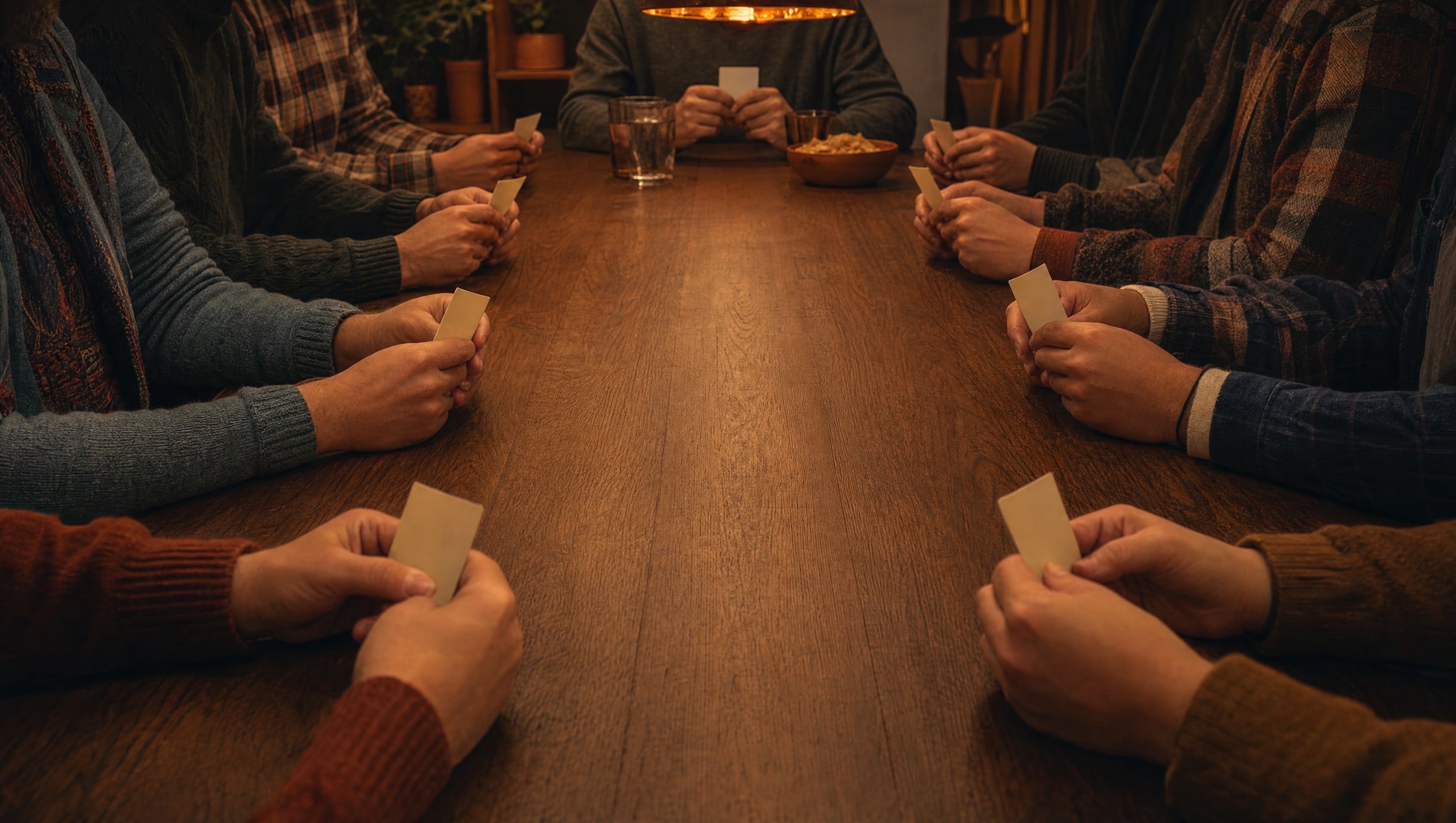
THE DETAIL
Every band is a kind of party game laid over a true player count, three to twelve. The hairline outline is the range a box of that kind prints on its side. The shaded run is the range that survives one piece of arithmetic: dead air — a single turn multiplied by everybody else — held under 90 seconds. Where a kind has everybody playing on everybody’s turn there is no dead air to compute and the band runs to whatever the components allow; where one person acts at a time the band stops early, and the hatching past it is the part the box promises and the room does not deliver. The ledger works trick ladder line by line so you can see the shading is a count and not a verdict.
FROM THE CURATOR
For two years my answer to a flat evening was a lighter box. Fewer icons, shorter rulebook, bigger pieces. It kept not working, and the reason took me an embarrassingly long time to see: the games I was replacing were not hard, they were slow to come back round. Nine people and a twenty-second turn means you are watching for three minutes at a stretch. Nobody in that room is confused. They are just not in the game.
Now I count differently. Before anything comes off the shelf I ask what everyone who is not the active player is doing — guessing, drawing, arguing, voting, anything — and if the honest answer is “watching”, the box goes back. It has cost me some genuinely lovely games on the nights the room is full, and it has never once cost me the night.
BY POPPY — CLASS: CURATOR · THEPINKPIPER.GG
5 PIECES · ON THE TABLE
What this path is holding room for. The first three titles were already queued for this space and stay exactly where they were. Nothing here is a link yet — a door that opens onto nothing costs you a click to find out.
01
The test is not how simple the rules are. It is whether somebody can join in wrong and still be doing the right thing.
BY IRIS · 5 MIN
02
Past ten the game stops being the thing you run and the room starts being it. Teams, timers, and what to hand out first.
BY IRIS · 6 MIN
03
Where the dead air actually accumulates — scoring, shuffling, and the person deciding — and the three places to cut it.
BY POPPY · 5 MIN
04
Two tables beat one queue. How to divide a room without anybody feeling sent to the smaller one.
BY POPPY · 6 MIN
05
Nobody is going to stop for you, and they should not have to. A teach built to be heard over a room, in ninety seconds.
BY IRIS · 4 MIN
SPACE 03 / 16 · CHAPTER 02 · GAME NIGHT · PATH 02 OF 03
Every chapter in this region is a space on this board. This one is 03, and you are standing on the second of its three paths — Party Games. Back to the board to roll for another.