01
How to weigh a figure against one you already know is real
The two-hand test, what a hollow copy sounds like when you tap it, and the one case where a kitchen scale settles it outright.
BY POPPY · 5 MIN
 How To: Gaming
THE HOW TO CO. — EDITION 10
How To: Gaming
THE HOW TO CO. — EDITION 10
A counterfeit is a good copy of the outside of a thing. Every place it saved money is a place you are allowed to look.
SIX CHECKS, AND THE ONE THAT PROVES NOTHING
A counterfeit is not a bad copy. It is a good copy of the outside of a thing, made by people who only ever had the outside to work from.
That is the sentence to hold on to, because it tells you where to look. A factory copying a blind box figure can photograph the sculpt, scan the carton and match the colours. What it cannot do cheaply is buy the tooling, the tampo machine and the press that made the original — and every one of those three leaves a mark you can find in a shop doorway with nothing but daylight and your thumb.
Start before the object. Almost every counterfeit reaches a collector through the secondary market: a marketplace listing, a reseller stall, a group order, a shop with a suspiciously deep stock of a series that sold out months ago. Buying from Pop Mart directly, or from a retailer the company itself lists, removes most of this problem at a stroke. Everywhere else, price is the first tell — a current series running well under retail is not a bargain, it is an answer.
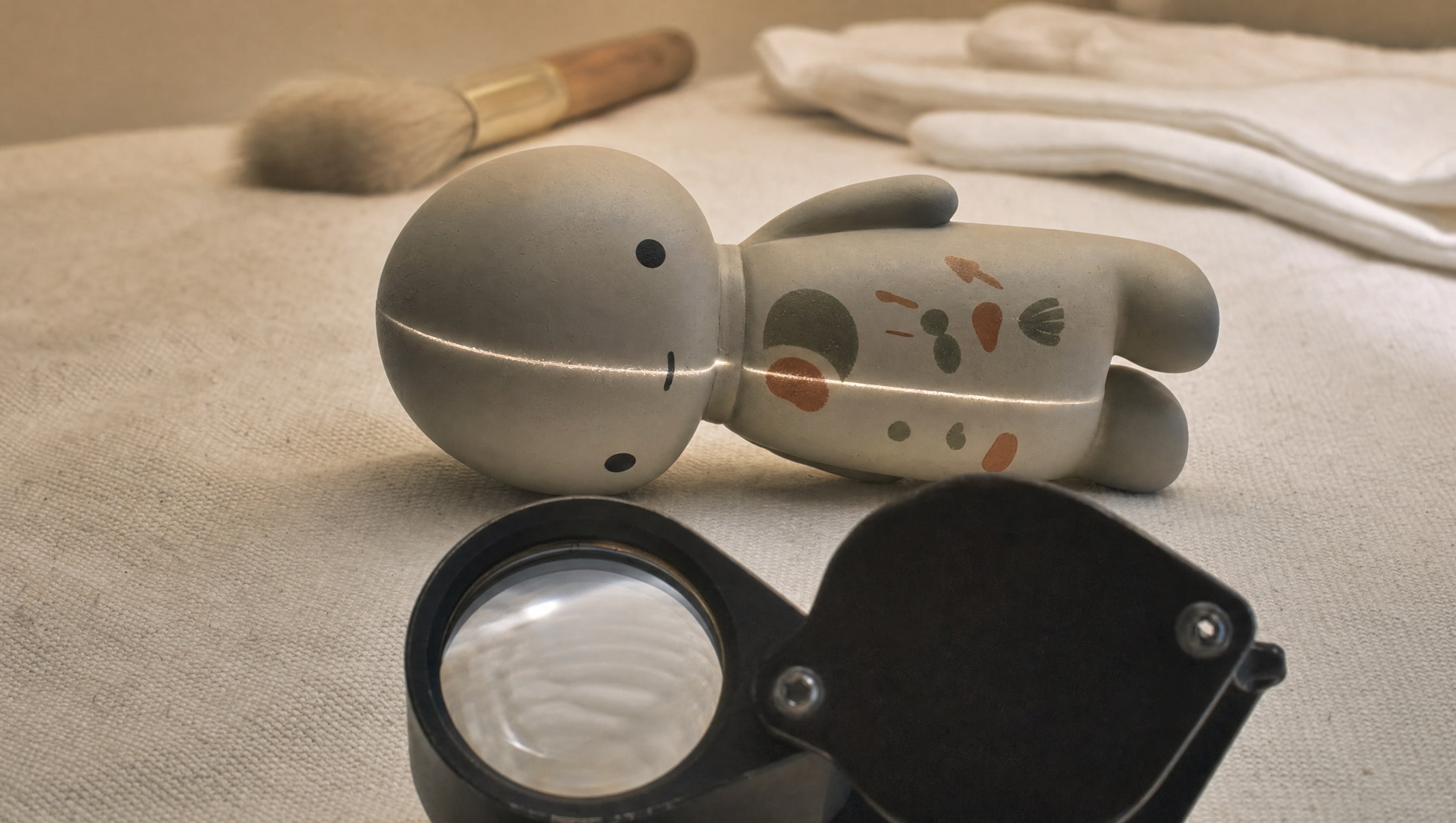
Then pick it up. Weight is the cheapest check there is and it is the one people skip. Copies routinely use less material and a softer mix, so a fake feels hollow and sounds different when you tap it. If you own the same figure from a sealed case, hold one in each hand; the difference is usually obvious before you have looked at anything. A sealed box tells you a little too — most current series pack the figure in a sealed inner bag, so a box that rattles loose, or a figure that arrives with no bag, has been opened by somebody.
THE CODE, AND WHY IT IS LAST
Most current Pop Mart boxes carry an anti-counterfeit label — a code you are meant to check against the company's own records. It is a real safeguard and it is also the check collectors lean on hardest, which is exactly why it is the first thing a counterfeiter copies. A printed code costs nothing to reproduce. What it buys the copyist is the thing that matters most: your confidence, spent before you have looked at the figure at all.
So verify it the way a code is meant to be verified. Open the company's own app or type its address in yourself, then enter the code by hand. Never let the label take you where it wants to go — a lookalike verification page is a morning's work for someone who has already tooled a mould. And read the answer properly: a code that reports as already verified is a code somebody has copied off a genuine box, and it is telling you so.
Which leaves the four checks in the drawing below, and they are the ones a copy cannot argue with. The seam, where the two halves of the mould met: on a genuine figure the join is dressed flush and you feel nothing under a fingernail, while a cheap tool leaves a step and a sliver of flash along it. The paint edge, which on a factory piece stops dead in the sculpt groove it was designed to stop in, and on a copy wanders across it with a haze of overspray beyond.
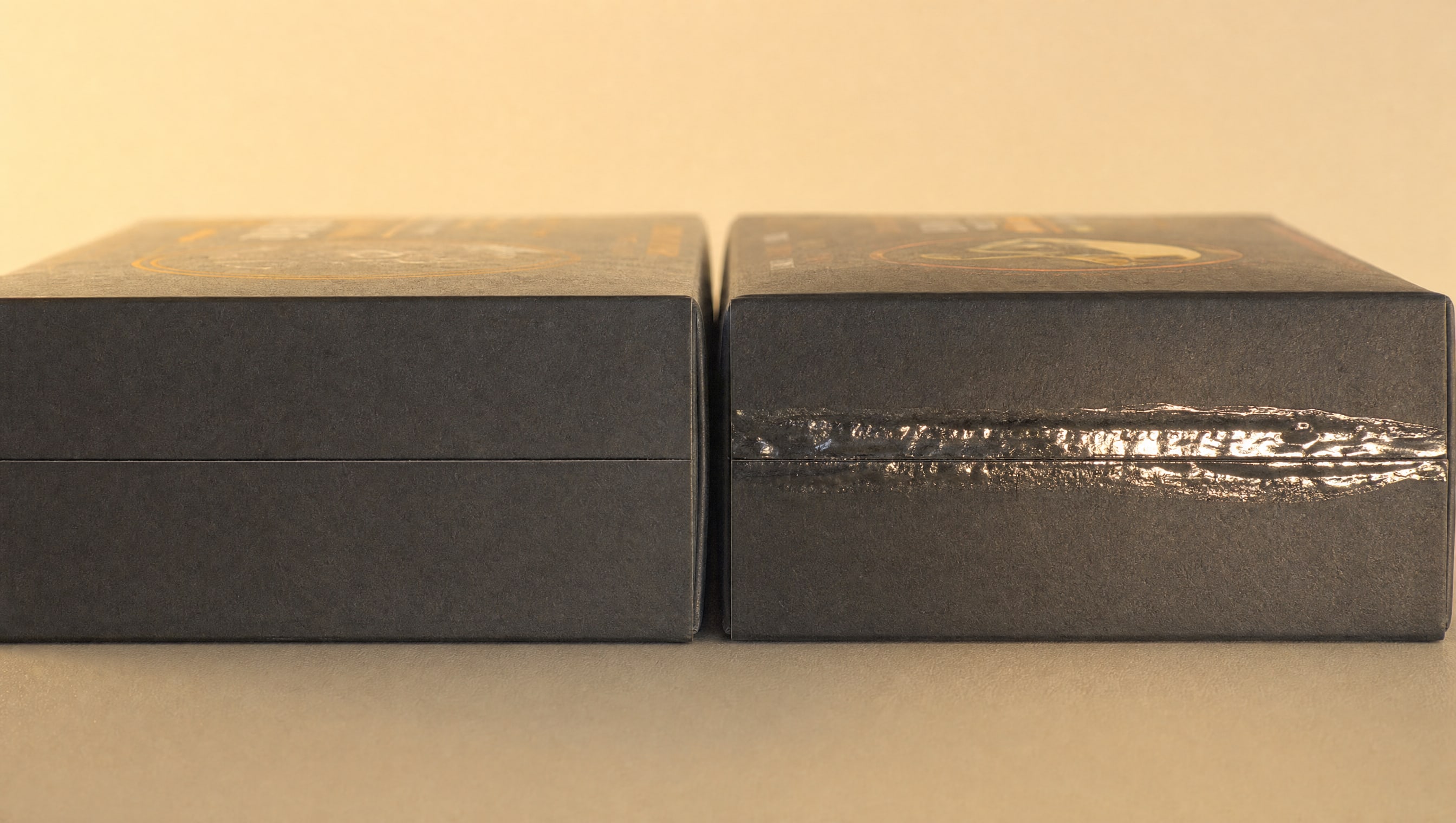
Then the two that need no more than a phone camera and good light. The foot stamp is cut into the tool itself, so on the real thing it is even, deep and sitting on one baseline; a copy taken from a moulding of a moulding comes out shallow, soft at the corners and out of line, often with paint filling half of it. And the box print: a licensed carton is printed fine and in register, while a copy shows a coarser dot, a channel walked off the others, and edges that go soft where they should be hard. Look at the object, in that order, and the code becomes what it should always have been — the last confirmation, not the first.
THE DETAIL
Two columns, as made and as copied. At full size they are the same drawing, called from the same code, because that is the honest position: a good counterfeit is the same object at arm’s length. The four rows underneath are loupe views, each set to its own millimetre rule printed in the margin — so what separates the columns is the size of a defect against a stated scale, not an opinion about it. Shapes are drawn at relative scale and are not measured from any one series.
5 PIECES · IN THE ARCHIVE
The archive behind this label, in the order a collector runs it — cheapest and freest first, loupe last. Titles are set and the pieces are being drafted; nothing here links yet, because a label pointing at an empty case is worse than a label that says wait.
01
The two-hand test, what a hollow copy sounds like when you tap it, and the one case where a kitchen scale settles it outright.
BY POPPY · 5 MIN
02
Open the company’s own app first, type the code by hand, and read what an already-verified answer is actually telling you.
BY IRIS · 6 MIN
03
Flush against proud, flash left on the join, and the angle the light has to come from before any of it shows.
BY POPPY · 5 MIN
04
Where paint is designed to stop, what overspray looks like beyond it, and why a printed face is the hardest part to fake.
BY IRIS · 7 MIN
05
The four photographs to ask a seller for, and what a coarse halftone says about the carton it was printed on.
BY POPPY · 6 MIN
SHELF 02 / 07 · BLIND BOXES
Every chapter in this region is a bay on this wall. This one is 02. Back to the wall to walk the rest.