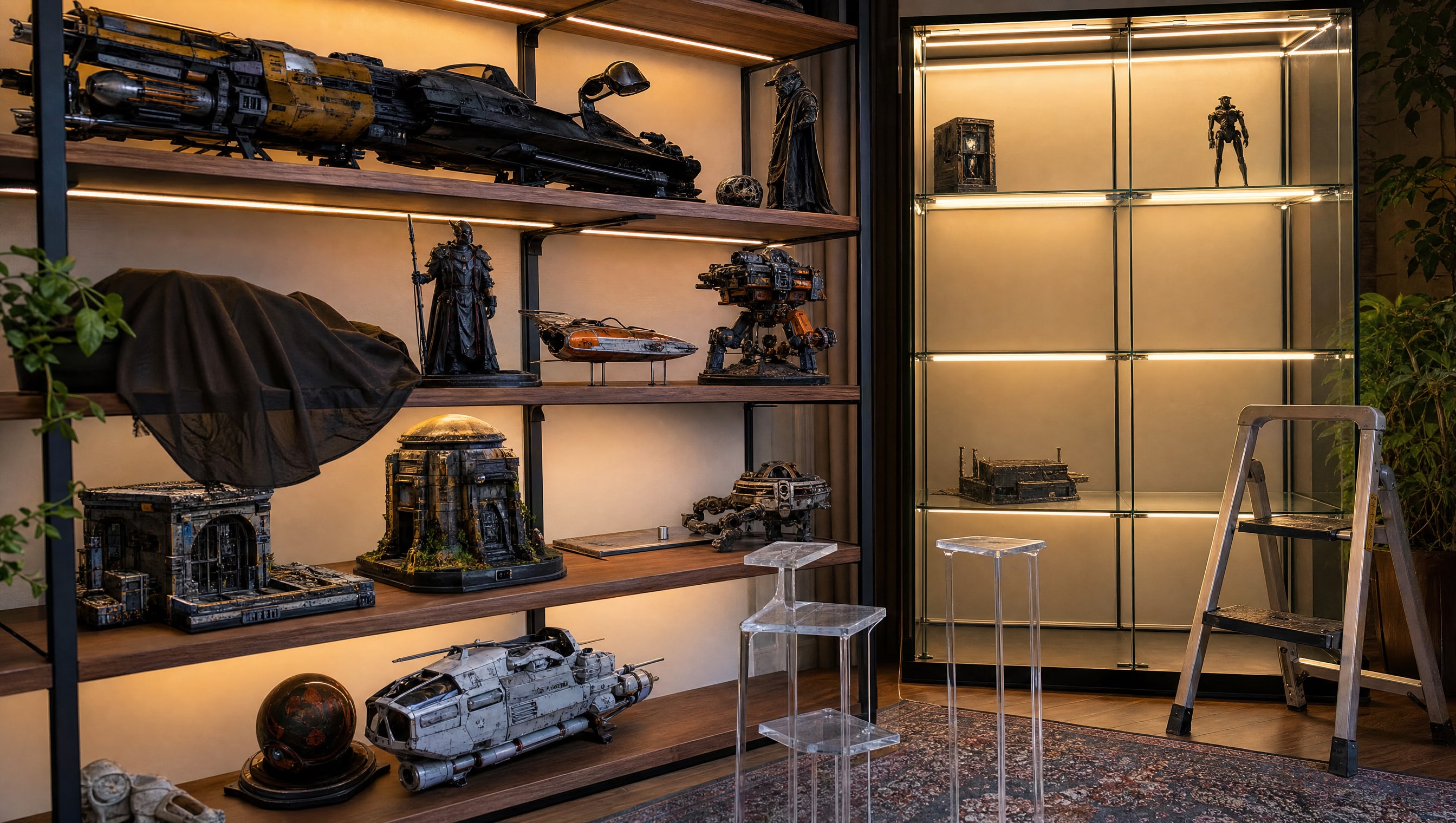
01
How to build a display case that holds its own weight
Shelf spans, glass thickness, and the load rating nobody checks until a shelf bows.
BY POPPY · 8 MIN
 How To: Gaming
THE HOW TO CO. — EDITION 10
How To: Gaming
THE HOW TO CO. — EDITION 10
Every chapter in this region is a bay on this wall. Back to the wall to walk the rest.
DRAWN IN THE GALLERY
The same collection, twice, in the same room under the same sun: open shelving near the window, a sealed and lit case behind it. Drawn at 0.4 units to the millimetre, so the clear heights down the right are the openings actually drawn rather than a pitch rounded for a tidy caption.
Coming in from the left is a low winter sun - four parallel rays, because sunlight does not fan out to suit a diagram, and it is the slope that decides which unit each ray finds. All four cross the same window and all four are turned at it: the film takes most of the ultraviolet straight back outside before any of them is in the room. That is one stop, and every ray in the drawing gets it.
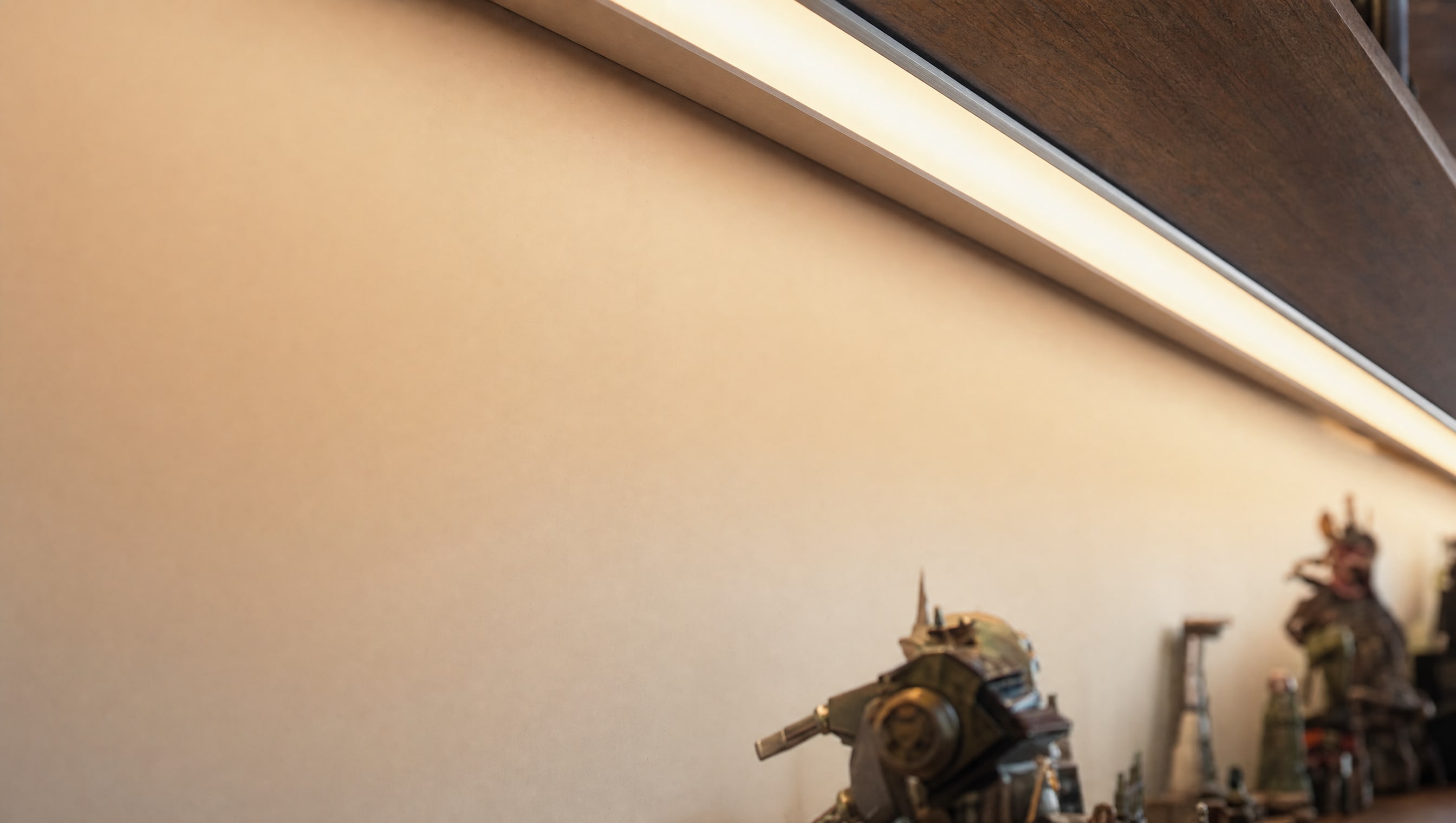
What separates the two halves is the second stop. Two rays clear the open shelving and reach the sealed case, where the glass front turns them again and what settles on the paint is the faint dashed remainder. The other two stop at the open unit, which has no front, so they cross it at whatever the film left them and land - along with the dust drawn settling on every open shelf. Pink does two jobs here and the drawing keeps them apart. Hatched and unfilled, it is film: the strip on the window, and the same strip magnified in the detail below it. Filled, it is the light you chose: an LED channel under each shelf of the sealed case, diffused, washing down the back so it lands on the object instead of on the glass.
STAGE IT · THEN DEFEND IT
Everything above is geometry. Both of the jobs it hands you are done standing up, with your hands, in about an afternoon each.
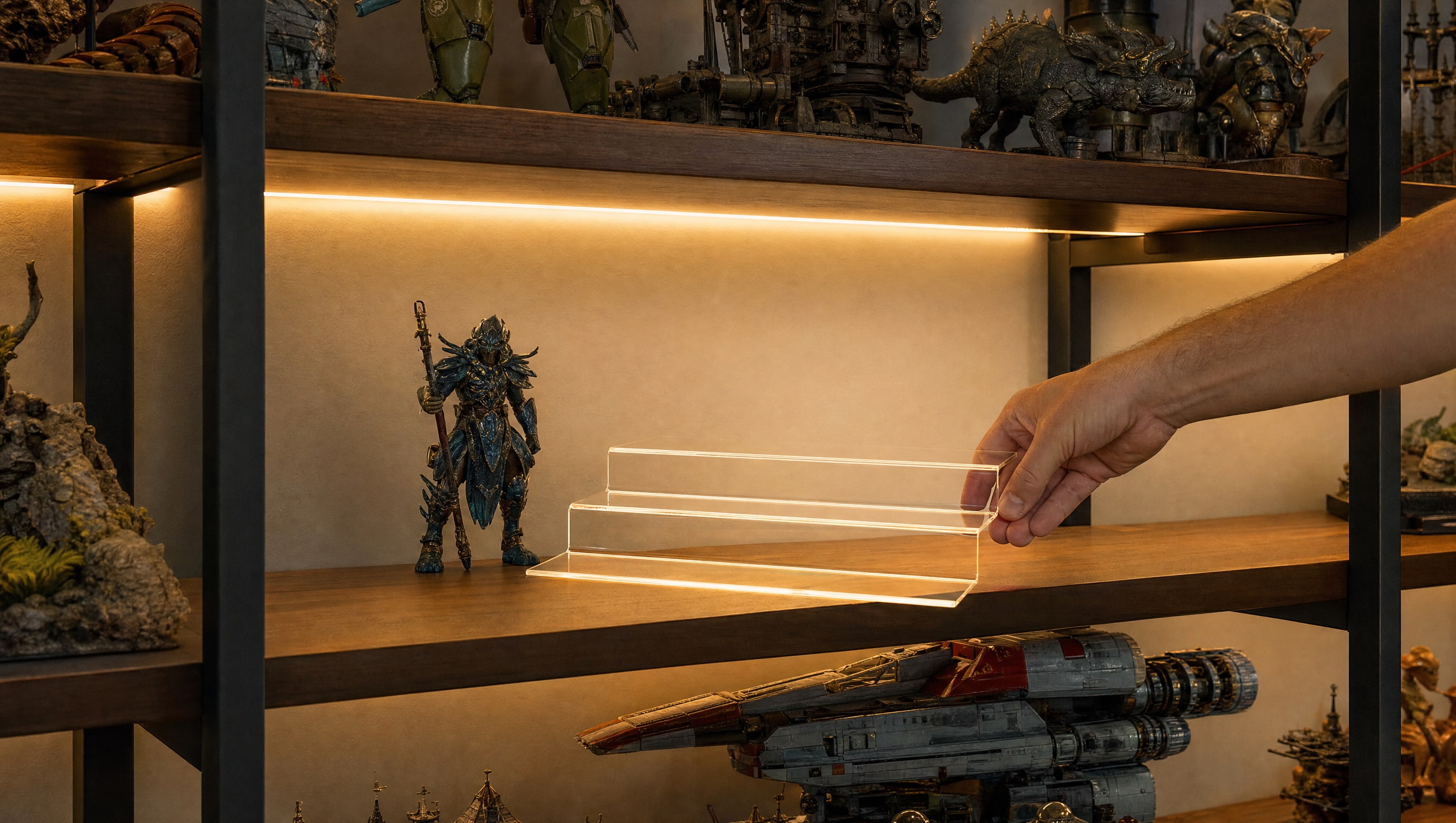
Height is the only thing a case gives you for free, and a riser is how you spend it. The back rank comes up, the front rank stops hiding it, and a 340mm opening starts holding three rows instead of one.
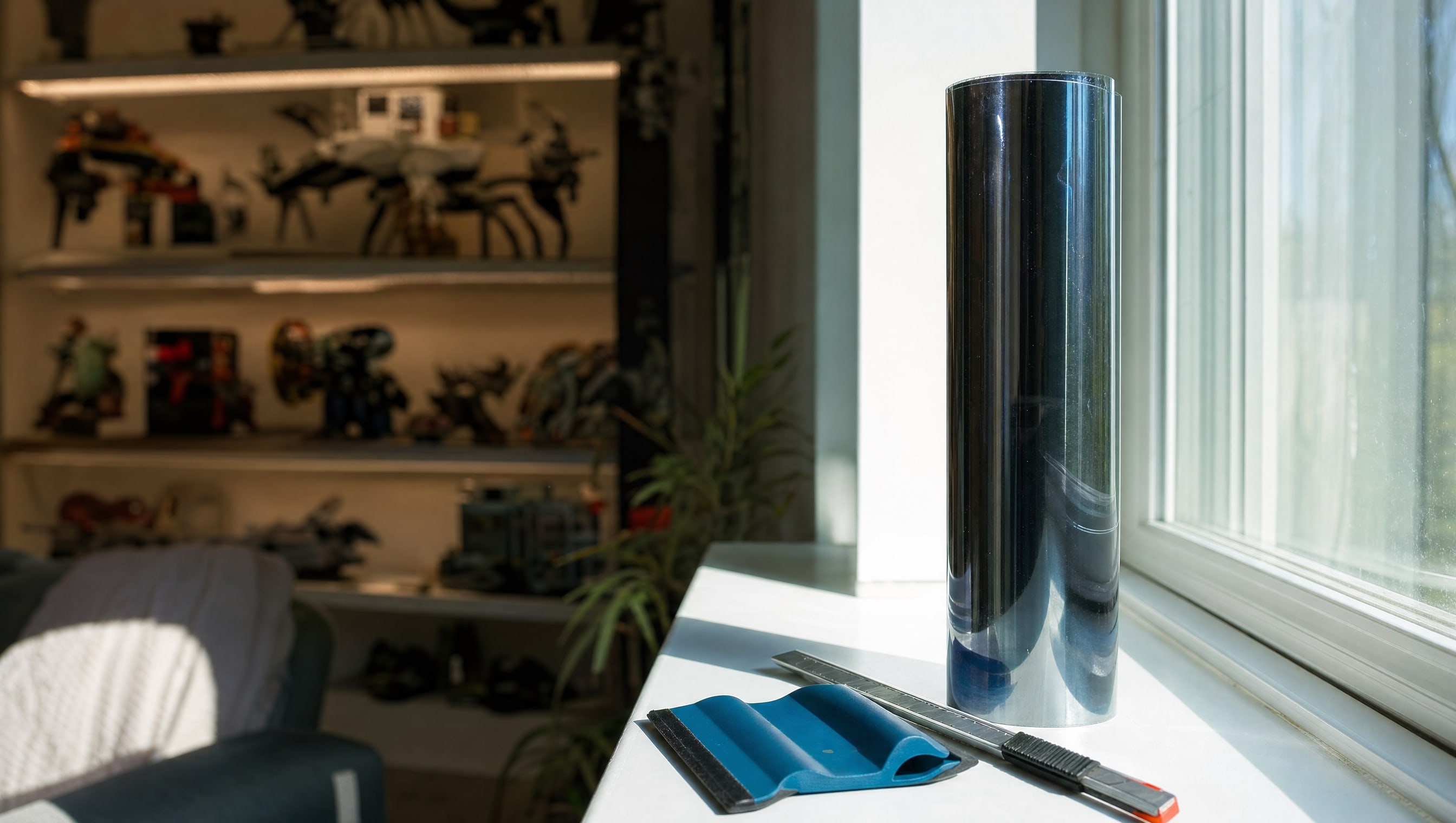
Film is the one stop every ray in the drawing has to cross, whichever unit it is heading for. It goes on the glass once, costs an afternoon, and takes the ultraviolet down before the room sees it. The case is what buys you the second stop after that.
SHELF 04 · CASES 01—03
Furniture, light, and the two things that eat a collection while you are at work. Take them in that order: a case you have not chosen cannot be lit, and light you have not aimed is just another source of heat.
FROM THE CURATOR
I have owned two kinds of shelf. The first looked wonderful for a fortnight and then quietly became a job: open shelving, a west-facing window, four rows of matte paint collecting a grey film I had to lift off with a brush every Sunday. The second is glass, sealed at the back, lit from under the lip, and I have dusted it twice this year. Same collection, same room, same owner. The difference was never discipline. It was deciding once, at the point of purchase, how much maintenance I was genuinely willing to sign up for, and then buying the case that matched the honest answer instead of the flattering one.
BY POPPY — CLASS: CURATOR · THEPINKPIPER.GG
5 PIECES · IN THE ARCHIVE
Five from the archive, written against this shelf. The titles are the plan; the pieces land as they are set.
01
Shelf spans, glass thickness, and the load rating nobody checks until a shelf bows.
BY POPPY · 8 MIN
02
Channel, diffuser, distance. Where the heat goes, and why CRI beats brightness.
BY POPPY · 6 MIN
03
Window film, orientation, and what separates fading paint from yellowing plastic.
BY IRIS · 5 MIN
04
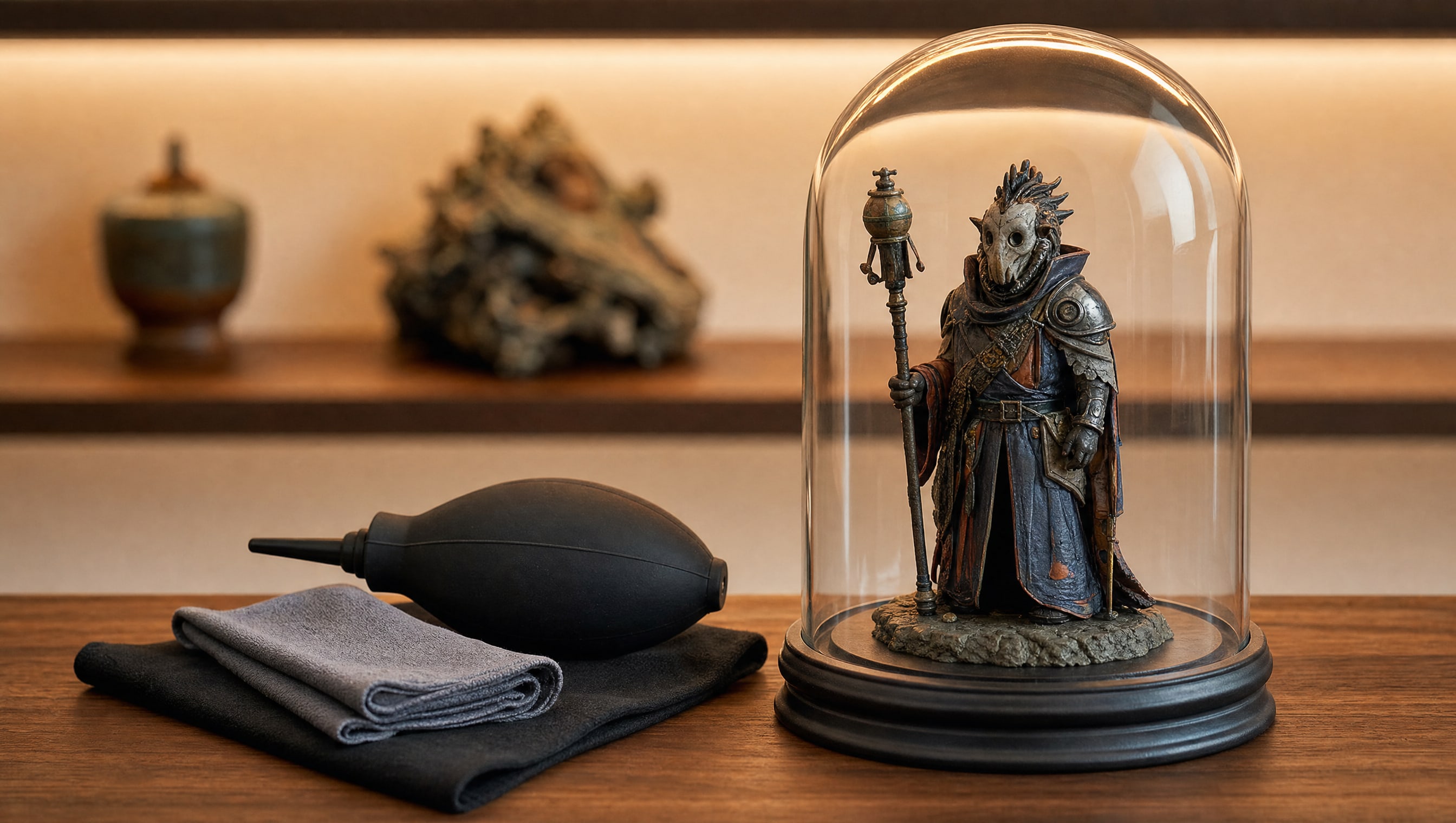
Blower first, brush second, cloth last - the order that keeps grit out of the paint.
BY POPPY · 4 MIN
05
Cost, weight, clarity, scratching. The three ways to stand a collection up, compared.
BY IRIS · 7 MIN