01
How to apply UV film to a glazed case without trapping bubbles
Cutting oversize, the slip solution, working the squeegee from the centre out, and where the film actually goes.
BY POPPY · 6 MIN
 How To: Gaming
THE HOW TO CO. — EDITION 10
How To: Gaming
THE HOW TO CO. — EDITION 10
Three different attacks, arriving at two different places. Every defence that works is sitting exactly where its hazard crosses the line.
THE INTRODUCTION
Dust, ultraviolet and damp are treated as one problem — “looking after it” — and they are three, with three different entrances. Sorting them by how they arrive is what turns an endless chore into two afternoons of work and one habit.
Start with the one that arrives without air. Ultraviolet comes straight through the glass, and ordinary glass is not the barrier people assume. Float glass stops nearly all UVB, which is why you do not sunburn behind a window, and then passes most of the UVA — around seventy per cent of it at the thickness a display case is glazed in. UVA is the half of the spectrum that actually breaks pigment bonds and yellows white plastic, so a sealed cabinet by a bright window is doing very little about the fastest damage in the room.
A UV-filtering film fixes that, and it fixes it almost completely: applied to the inside face of the glazing, it takes transmitted ultraviolet to under one per cent. Fifty microns of polyester, one afternoon, and the fastest-acting agent in the room is gone. What it does not do is stop fading, and this is where most advice quietly lies to you. Visible light fades pigment too, just more slowly, and fading is cumulative — it is a function of how much light has fallen on the object in total. Film buys you a large multiple of time. Keeping the case out of direct sun and switching the shelf lights off when you leave the room buys you the rest.
Dust and damp are the other door, and they arrive together because they both ride on air. Household dust is skin, textile fibre, soot and mineral grit, and the grit is the part that matters: it is harder than acrylic paint, so a cloth dragged over a dusty figure is fine abrasive on a soft surface. The honest fix is not a better cleaning habit, it is less air. Air gets into a cabinet at the door — the door perimeter is by far the longest joint in the box — so a closed-cell foam gasket, six millimetres free, compressed into a three-millimetre gap, does more for a collection than any brush.
Damp is the slow one and the one people over-buy for. Museums hold cases between 45 and 55 per cent relative humidity for a reason: above about 65 per cent mould germinates on organic surfaces and metal fittings begin to corrode; below about 40 per cent, plasticised vinyl stiffens and organic materials shrink and check. An uncontrolled room in a temperate house crosses both ends of that in a year. Silica gel buffers the air it is sealed in with, and the museum convention is twenty kilos of conditioned gel per cubic metre of case volume — which for the cabinet drawn below works out at eleven and a half kilos. A household tub of beads is around two hundred grams. It will smooth an excursion after the door has been open; it will not hold a season, and no honest reading of the numbers says otherwise. The gasket is what makes the gel worth having at all, because in a leaky case the beads saturate in days.
One more thing, because this shelf covers acrylic domes as well as glass cases. Acrylic is far softer than glass and it scratches from dry wiping alone; it also holds a static charge, which is why a dome collects dust faster than the glass beside it. Never put an ammonia-based glass cleaner near it — ammonia crazes acrylic, and crazing is a permanent web of fine cracks, not a mark you can polish out. A drop of dish soap in distilled water and a clean, wet microfibre is the whole method.

THE DETAIL
One case, cut through, at 0.42 units to the millimetre. The three defences are drawn where they actually sit, against a scale in millimetres above the room floor — film on the inside face of the glazing for the full 1600 of opening, gasket at the seam at 100 and at 1700, silica on the floor between 100 and 140, where a tray steals no display height. Each one is measured beside it: the seam blown up against its own ten-millimetre bar, what crosses the glass with the film and without, and how much gel a case of 0.576 cubic metres honestly wants.
WHAT THE SEAL DOES NOT CATCH
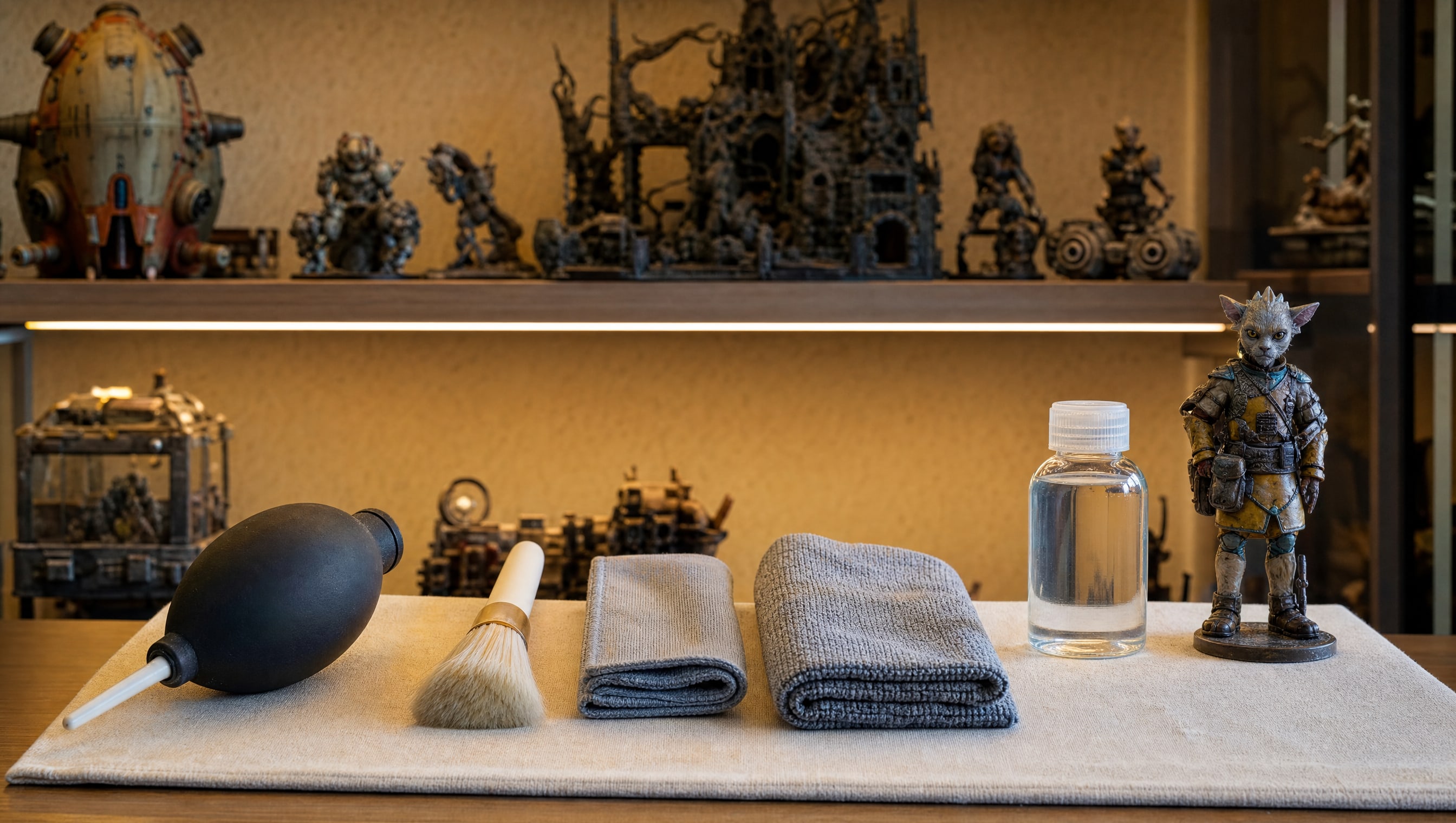
No case is airtight, so dust still lands — just far more slowly, and far more evenly. What you do about it is four tools used in one fixed order, because the order is the whole method: every step exists to get grit off the surface before anything touches it.
5 PIECES · IN THE ARCHIVE
The archive behind this label, in the order the work runs in — glaze it, seal it, buffer it, then keep it. Titles are set and the pieces are being written; nothing here links yet, because a label pointing at an empty case is worse than a label that says wait.
01
Cutting oversize, the slip solution, working the squeegee from the centre out, and where the film actually goes.
BY POPPY · 6 MIN
02
Measuring the gap, choosing closed-cell over open-cell foam, and the magnet catch that keeps the compression honest.
BY POPPY · 7 MIN
03
Case volume, the museum dose, what a tub of beads is actually good for, and drying them out in a low oven.
BY IRIS · 6 MIN
04
Why acrylic holds static, the cleaners that destroy it, and the wet-cloth method that leaves it clear.
BY IRIS · 5 MIN
05
Where to put the gauge, what a seasonal swing looks like, and the two readings that mean do something today.
BY POPPY · 5 MIN
SHELF 04 / 07 · DISPLAY & CARE · CASE 03 / 03
Every chapter in this region is a bay on this wall. Bay 04 is Display & Care — furniture, then light, then this. Case 03 is the last of the three standing inside it, and the only one about what the case is keeping out rather than what it holds up. Back to the wall to walk the rest.