01
How to dust a plush without pulling the pile
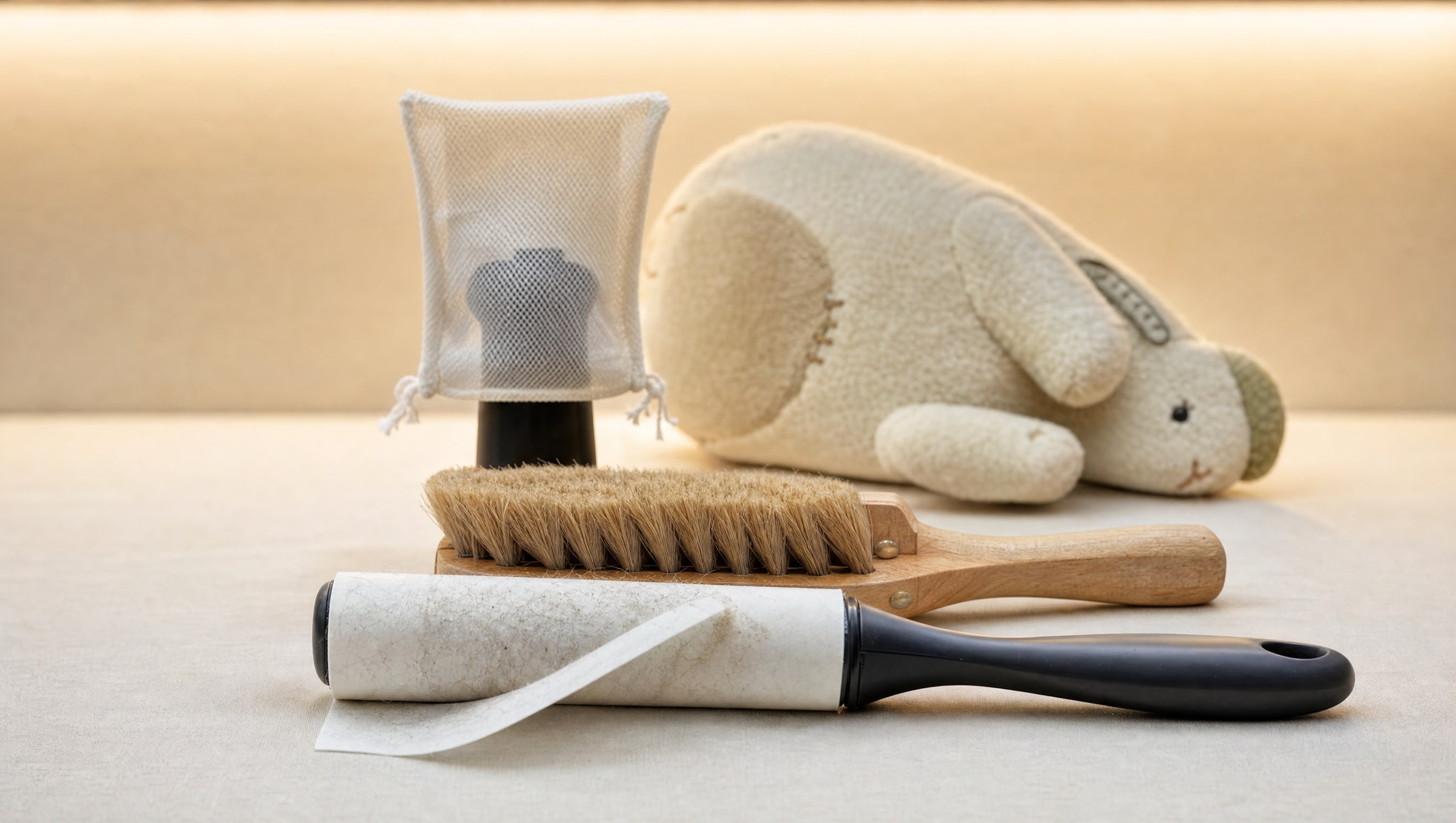
Roller, then brush with the nap, then a vacuum run through nylon mesh on its lowest setting. The whole dry sequence, in order.
BY POPPY · 5 MIN
 How To: Gaming
THE HOW TO CO. — EDITION 10
How To: Gaming
THE HOW TO CO. — EDITION 10
Everything that dirties a plush is sitting in the top of the pile. Everything that ruins one went deeper than it needed to.
THE ORDER OF OPERATIONS
A plush is not dirty all the way through. It is dirty at the top — and the ones ruined in the cleaning were ruined by going deeper than the dirt.
Structurally it is three things. A pile of cut fibre a few millimetres deep, tufted into a knit backing about a millimetre thick, with polyester fill behind that. Dust, hair, skin oil and smoke residue land on the tips and work down a millimetre or two; the backing stops them; the fill almost never sees any of it. What the fill is very good at is holding water — it is mostly air, and air spaces wick and keep. That asymmetry is the whole subject. Soil is shallow, water goes deep, and the job is to get one out without putting the other in.
So the work runs shallow to deep and stops the moment the mark is gone. Roller for what is loose on the tips. A soft brush, worked with the nap and never against it, to lift the pile and bring embedded dust up where it can be taken away. A vacuum on its lowest setting through a square of nylon mesh — the mesh is not optional, because bare suction pulls tufts out of the backing and leaves bald patches that no amount of brushing puts back. Most plush on most shelves never needs anything past that.
ONCE WATER IS INVOLVED
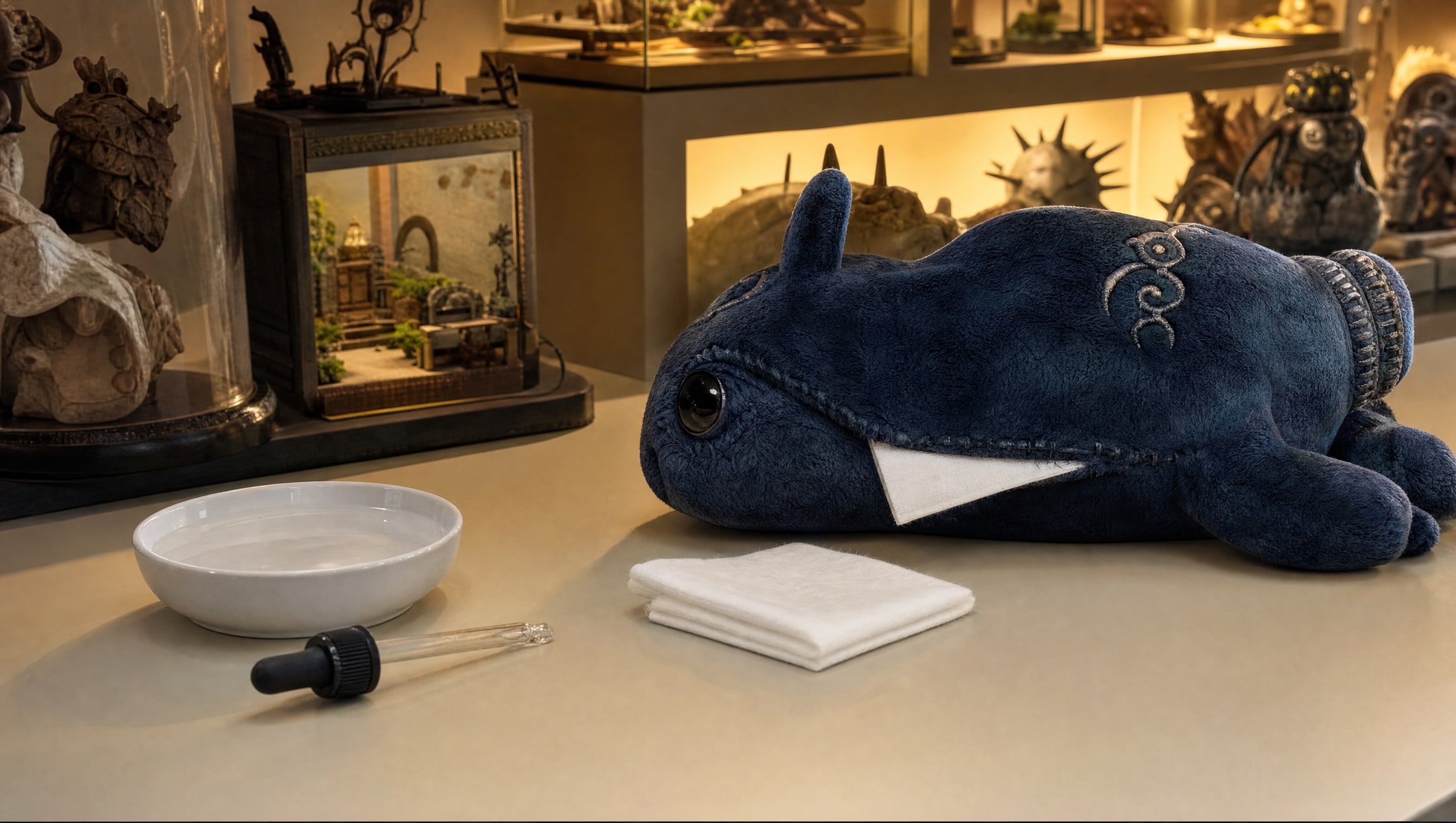
Before any water at all, test. Press a damp white cotton cloth against a hidden seam — under an arm, behind an ear — and hold it for thirty seconds. If colour comes off on the cloth, that plush is not washable at any temperature, and the answer is dry methods for the rest of its life. Vintage pieces fail this test constantly, and a red or black plush that bleeds will run into every pale panel it touches on the way through the water.
If it passes and there is a mark, spot clean: a drop of clear, dye-free detergent in cool water, a barely damp cloth, and blot from the outside of the mark inwards. Never rub. Rubbing felts the pile — the fibres tangle into a mat that is permanent and shows worse than the stain did. And keep enzyme detergents away from anything old: mohair and wool are protein fibres, and a biological detergent is designed to digest exactly that.
Two things come off before water and one never does. The swing tag comes off first — cardboard cockles the moment it gets damp and the print lifts, and on a limited run that tag is a serious share of what the piece is worth. Unpick the thread, store it flat in a rigid sleeve, sew it back after. Batteries and sound boxes come out if the seam allows, and the plush stays dry if they do not. The sewn tag in the seam never comes off, for any reason — cutting it is the fastest way there is to halve a plush's value.
Then drying, which is the part that actually goes wrong. Press the water out against the side of the basin, never wring; wringing twists the fill into ropes that set. Roll the piece in a towel and stand on it. Reshape it while it is damp, working the fill back out into the ears and the paws. Then moving air, no heat, for as long as it takes — a fan across it in a dry room, turned every few hours, two to three days for anything the size of a cat. A tumble dryer crimps polyester fill into permanent lumps and softens the glue behind eyes and noses; direct sun yellows white plush in an afternoon; and fill still damp on day three in a closed room is where the smell that never comes out begins.
THE DETAIL
The model is a short-pile plush: six millimetres of pile tufted into a one-millimetre knit backing, polyester fill behind it. The axis running down the page is depth below the pile tips in millimetres, and it is the only quantity in the drawing — each bar runs from the tips to the depth that method actually gets to. One cut carries the whole thickness at true scale; the other lifts the top eight millimetres and enlarges them, because that is where six of the seven methods live and where the differences between them are. Each cut prints its own enlargement.
5 PIECES · IN THE ARCHIVE
The archive behind this case, written to the same order the work runs in. Titles are set and the pieces are being drafted — nothing here links yet, because a label pointing at an empty case is worse than a label that says wait.
01
Roller, then brush with the nap, then a vacuum run through nylon mesh on its lowest setting. The whole dry sequence, in order.
BY POPPY · 5 MIN
02
A white cloth, a hidden seam, thirty seconds. What a stain on that cloth rules out, and what to do with a plush that fails.
BY POPPY · 4 MIN
03
Work from the outside of the mark inwards, keep the cloth barely damp, and stop before the backing is wet.
BY IRIS · 5 MIN
04
The narrow set of pieces that survive water, the detergent to keep away from vintage fibre, and the parts that come out first.
BY POPPY · 7 MIN
05
Surface dry in an afternoon, fill dry on day three. The weight check, the seam check, and why heat is not the shortcut.
BY POPPY · 6 MIN
SHELF 03 / 07 · PLUSH · CASE 01 / 03
Every chapter in this region is a bay on this wall. This one is 03, and you are at case 01 of 03 on it — Cleaning & Care. Back to the wall to walk the rest.