THE CARTRIDGE
Structurally, a cartridge is close to indestructible. The shell is a couple of millimetres of ABS, the board is ordinary glass-epoxy, and the game itself lives in a mask ROM — a chip whose contents were fixed by a photographic mask at the plant and cannot be rewritten by time, damp, magnets or a dropped bag. That is why carts are still here and why so many of them still boot on the first try after thirty years in a loft.
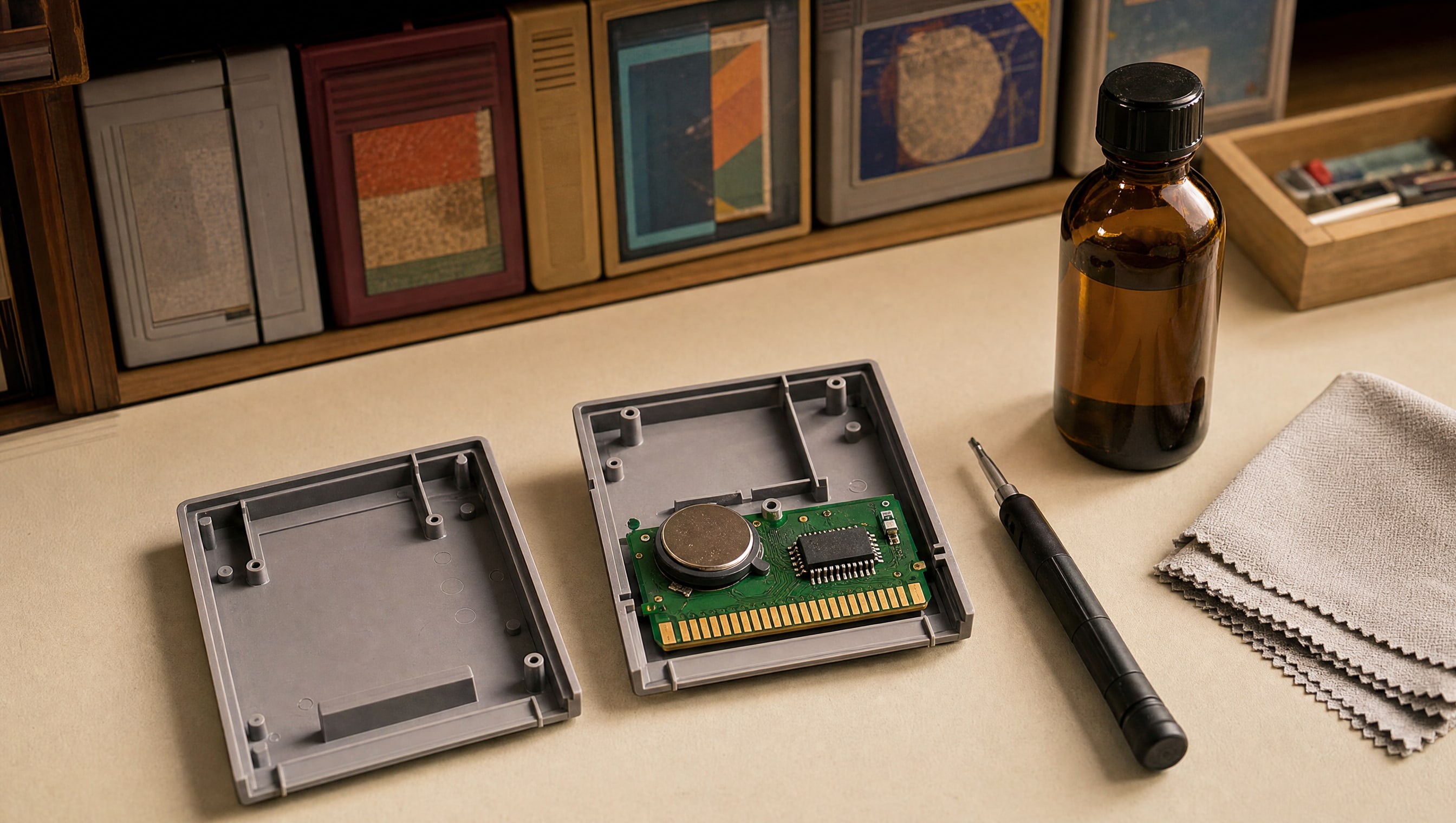
What does not survive is the save. Any game that remembered anything kept it in static RAM, and static RAM forgets the instant the power stops, so a three-volt lithium cell was soldered to the board to keep it awake. Nobody at the factory was designing for 2026. Most of those cells are now past their working life, and a cart with a dead one plays perfectly — it simply stops remembering, usually the second time you switch it on. Replacing it is a soldering job, and it wipes whatever the old cell was still holding, which is the part people are not told first.
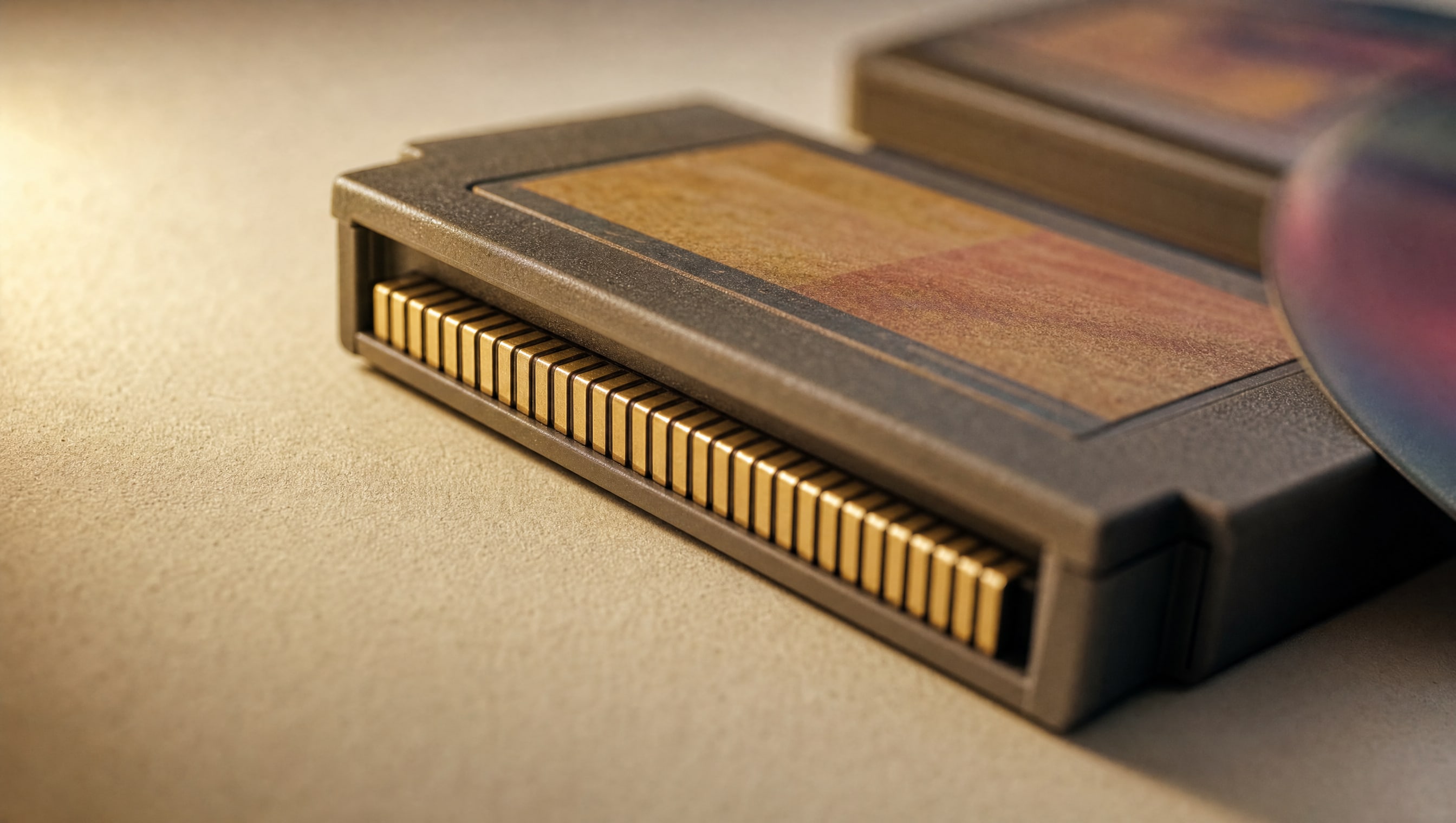
The other complaint is not damage at all. The fingers on the edge connector are hard gold about a micron thick over nickel; gold does not corrode, but a damp cupboard will film the whole strip with everything else it has. That comes off with high-strength isopropanol and a lint-free cloth, drawn along the fingers rather than across them. Never a cotton bud, which sheds. Never blowing into the slot, which is warm water vapour aimed at a contact.
THE DISC
A disc looks like a solid object and is really a stack. Under your thumb: about five microns of screen-printed label, ten microns of lacquer, then a mirror of aluminium roughly eighty nanometres thick, then a spiral of pits moulded into the top face of 1.2 millimetres of clear polycarbonate. Everything that matters is in the top fifteen microns, and it is closer to the printed side than the thickness of a sheet of kitchen foil.
Which inverts what everyone thinks they know. The shiny face is the armour: the laser has to climb 1.2 millimetres of plastic to reach the data and its beam is nearly a millimetre wide where it enters, so a fine scratch down there is badly out of focus by the time it matters. A scratch on the printed side is fifteen microns from the mirror. A ballpoint will do it. A peeled sticker has taken the mirror off with it more than once.
And the mirror has its own clock. Where the lacquer was thin, or the edge was sealed badly, air reaches the aluminium and it oxidises — bronze first, then patchy, then a disc you can read a newspaper through. It is not common and it is not universal, but it is not repairable either, and it is the one failure a perfect cupboard does not prevent. Which is the honest reason to rip a disc library you care about, and to keep the discs anyway.